Comparison guide · Meeting & collaboration · 06
Seated vs standing-height collaboration tables: keep everyone in the conversation
A tall project table can look inviting in an office photograph. In use, the important question is whether everyone can take part in the work happening around it.
Get the short answer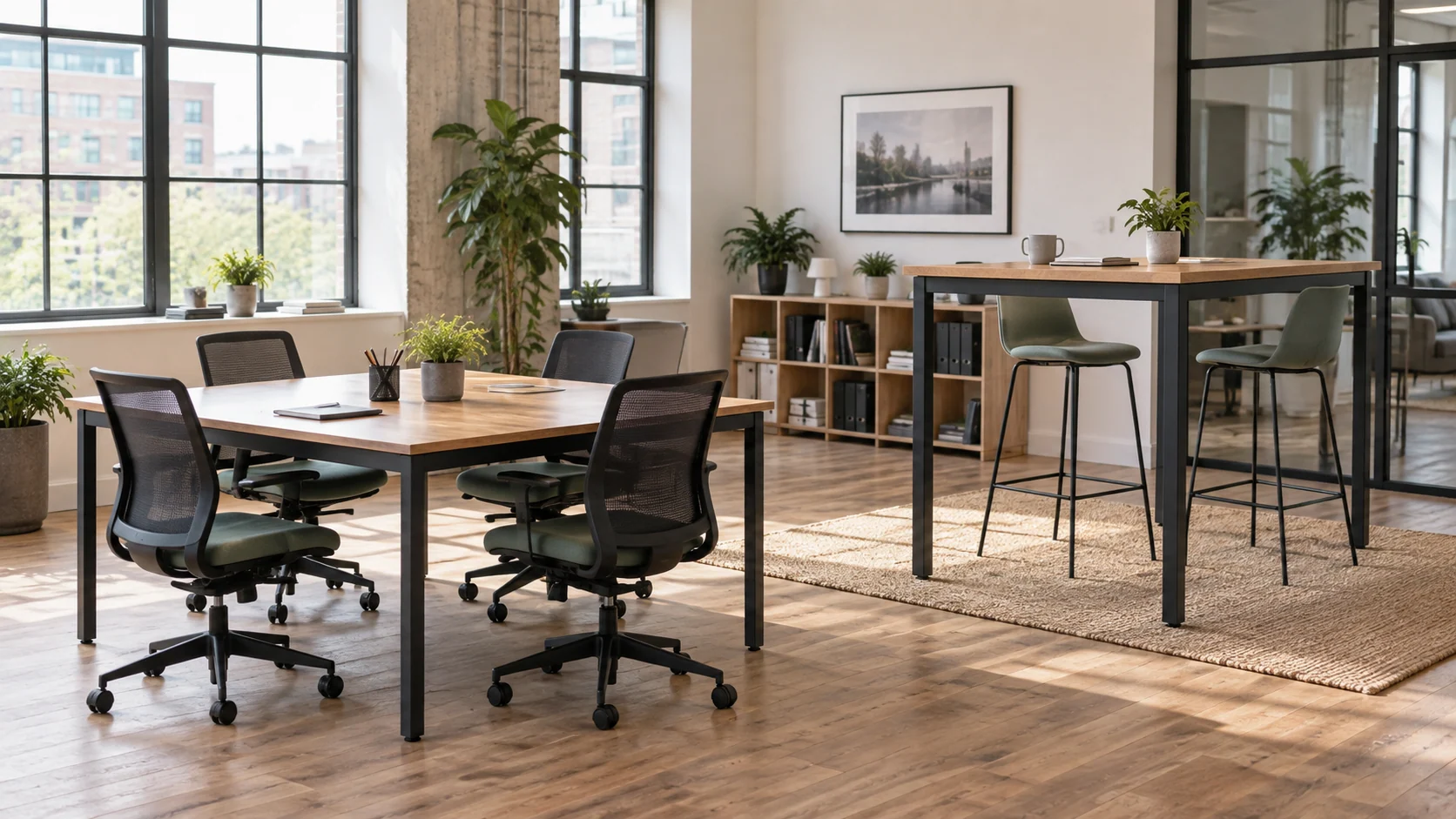
Short answer
Seated-height tables often suit longer discussions and work with standard-height chairs. Standing-height tables can suit short shared tasks or work at a raised surface, but need an inclusive participation plan. Adjustable-height tables may offer flexibility where their range and operation suit the group.
Choose on purpose
Which option fits which situation?
Choose seated height for a shared activity where people need a sustained seated position and suitable approach space.
Choose standing height for a task that benefits from a raised surface only when everyone can participate appropriately; consider adjustable height where useful.
Side by side
Seated vs standing-height collaboration tables
| Decision | Seated-height tables | Standing-height tables |
|---|---|---|
| Typical use | Discussion and shared seated work | Short sessions or raised-surface tasks |
| Seating | Compatible standard-height chairs | Suitable higher seating may be needed |
| Participation | Check approach space and underside clearance | Plan an equivalent way for seated users to join |
| Materials | Check seated reach across the surface | Check reach without leaning over the work |
| Long sessions | Assess the chair and whole setup | Do not assume everyone can stand throughout |
| Alternative | A suitable seated arrangement | Adjustable height where useful and appropriate |
Practical example
Keep everyone at the same activity
An inclusion-led planning check, not a universal height or clearance specification.
| Check | Option or calculation | What it tells you |
|---|---|---|
| View | Can each participant see the shared material? | Do not leave a seated person outside the group |
| Reach | Can the work be reached from their position? | A nearby low table may not give equivalent access |
| Operation | Can the arrangement change when needed? | Check controls, approach and cable travel |
For a shared review of samples or drawings, the surface must work for the whole group. Offering a tall stool does not automatically solve access, balance or transfer needs. Discuss the task and participants before choosing a fixed raised table.
An adjustable model can offer another option, but check its complete range, intended use and behaviour with equipment in place. The ability to move does not by itself prove that the final arrangement is suitable. Assess the table, seating, surrounding route and shared materials together.
A practical route to a decision
Record the room, route and working clearances.
List what the users and the task actually require.
Compare the condition and completeness of the real options.
Know what is being compared
Seated-height tables
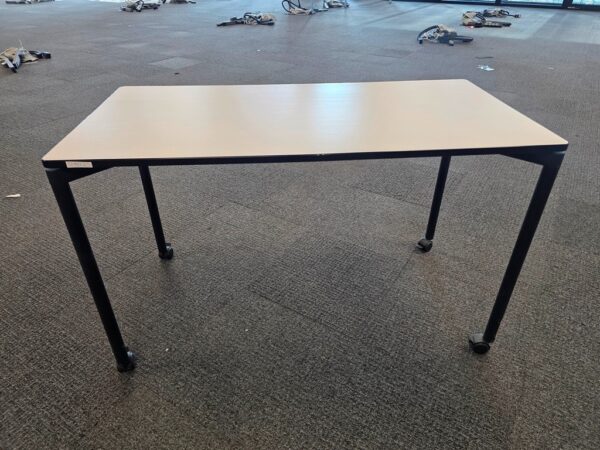
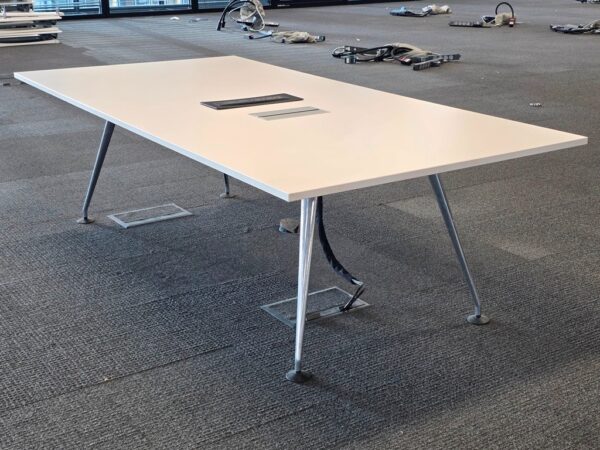
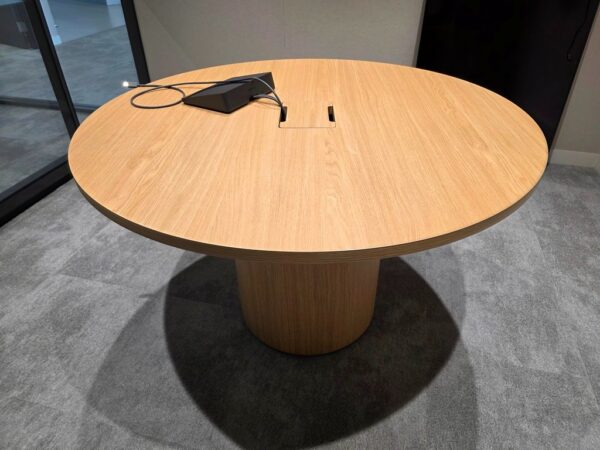
A seated-height collaboration table is intended for use with compatible seated working positions. Check the actual top height, underside clearance and chair arrangement.
Standing-height tables
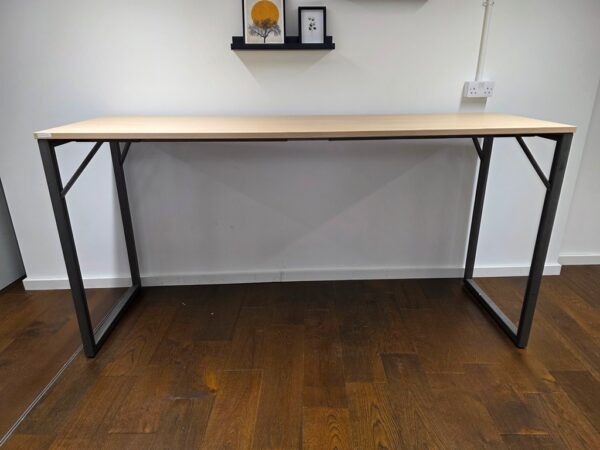
A standing-height collaboration table has a raised working surface. It is not necessarily height-adjustable, and a stool does not make every tall table suitable for every user.
The details that change the decision
Choose the height from the task and the people
A quick discussion around samples is different from several hours working on a laptop. Specify what happens at the table and how long a typical session lasts. Then consider the people using it rather than assuming one posture works for everyone.
Avoid choosing tall furniture simply because it is described as more energetic or collaborative. The table cannot guarantee better ideas or shorter meetings. Its value is whether it gives the group a workable shared surface.
A nearby low table is not always equal participation
If the main discussion and materials stay at a tall table, someone seated separately can be left out of the activity. Plan a shared arrangement where people can see, reach and contribute, including those who cannot stand comfortably.
Compare an appropriate seated table or a suitable adjustable model. Check approach space, knee clearance, controls and cable travel. The whole arrangement needs assessment; a height-adjustable label alone does not establish accessibility.
Check the chair-to-table relationship
Where higher seating is appropriate, match its usable seat range to the surface and provide suitable foot support. A tall chair that reaches the tabletop but leaves the user perched awkwardly is not a successful match.
For used adjustable furniture, ask for a complete demonstration across its range, with the correct controls and components present. Check the manufacturer’s instructions for clearance and use. For regular screen work, assess the full workstation rather than treating the table height as the only decision.
Put it in a real room
A project group that changes from week to week
A facilities team cannot predict every visitor’s preferred or possible working position. A fixed standing-height table may serve some short sessions well, but a shared seated arrangement or suitable adjustable table can offer more options. Test participation with the materials and equipment in place before making the raised table the only project workspace.
Before ordering
Five checks worth doing
- 01Record session length, task and materials.
- 02Include people who need to remain seated.
- 03Match seating, foot support and underside clearance.
- 04Check controls, cables and the full adjustment range where fitted.
- 05Assess regular screen-work setups as a whole.
Clear answers
Frequently asked questions
Do standing tables make meetings shorter?
Do not rely on the furniture to produce that outcome. Meeting length depends on the activity and how it is run.
Can everyone use a standing-height table with a stool?
No. Higher seating does not suit every person or access requirement. Provide a genuinely usable shared arrangement.
Is an adjustable table always the best choice?
Not automatically. Its range, controls, clearance, condition and usefulness to the group need checking.
Useful source material
Ready to compare real options?
Take the brief to current stock.
Compare current tables with your chairs, room layout and presentation requirements. Condition, quantity, price and delivery can change, so verify the current listing and order details.