Comparison guide · Meeting & collaboration · 04
Round vs square meeting tables: a small-room comparison
For a small meeting area, round and square tables can seem almost interchangeable. At the same stated width, though, they do not provide the same surface or the same edges to sit against.
Get the short answer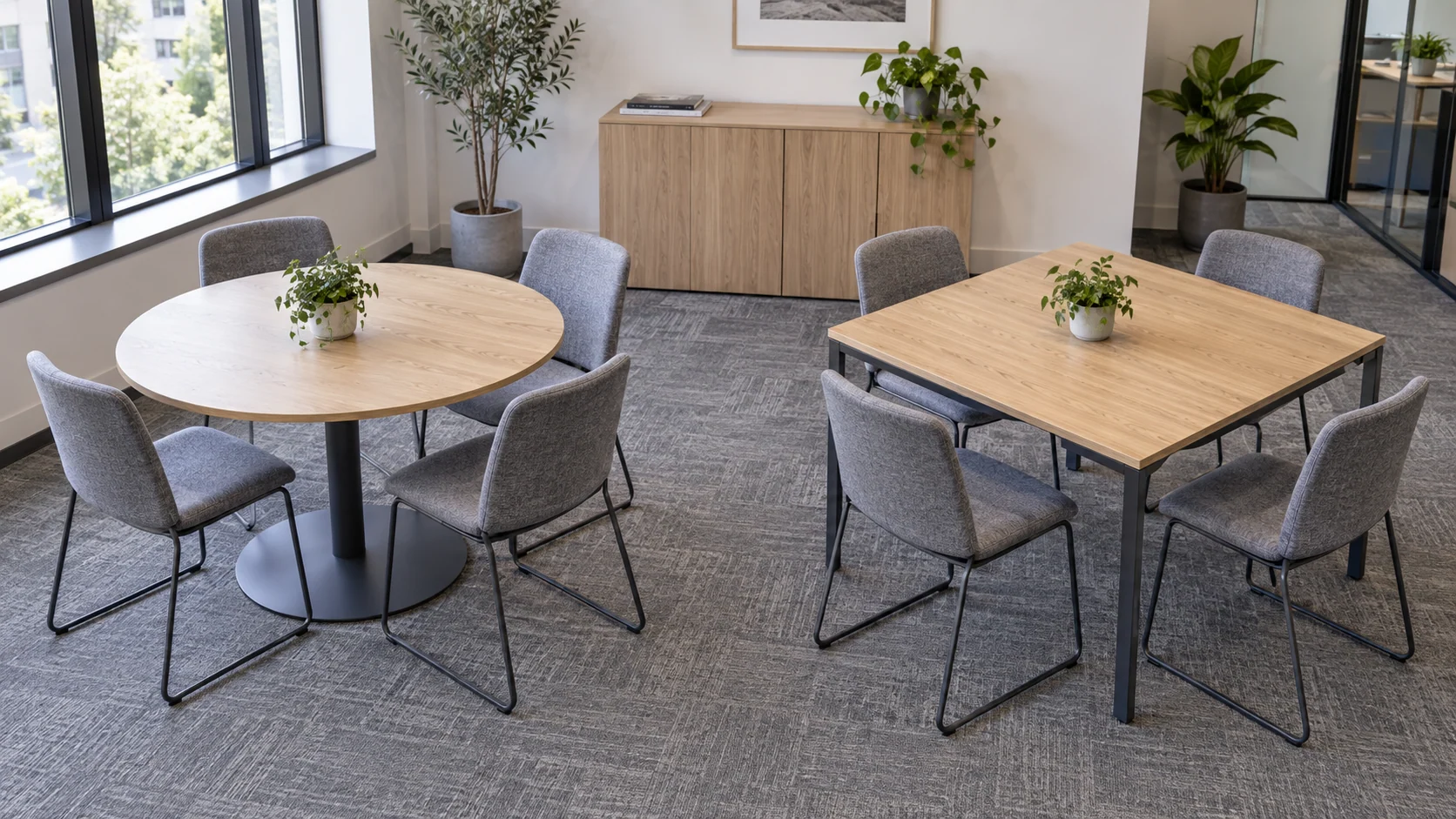
Short answer
Choose round when a continuous edge and flexible positions suit the group. Choose square when defined sides, corner surface or alignment with other furniture is useful. Check the base, chair positions and surrounding space; neither shape guarantees a better fit in a small room.
Choose on purpose
Which option fits which situation?
Choose round when flexible seat positions and the lack of projecting tabletop corners suit the room.
Choose square when straight edges, corner surface or alignment with other furniture serve a useful purpose.
Know what is being compared
Round meeting tables
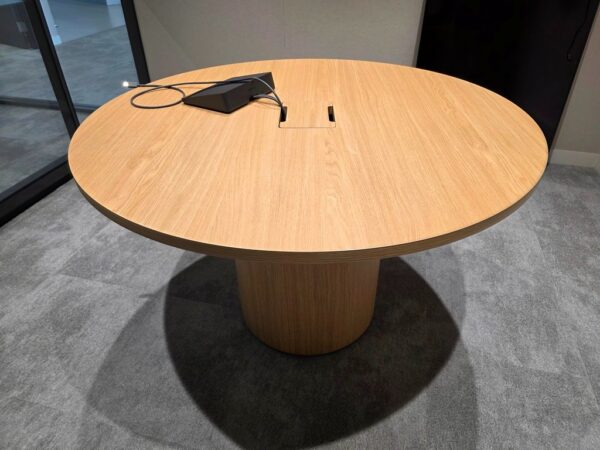
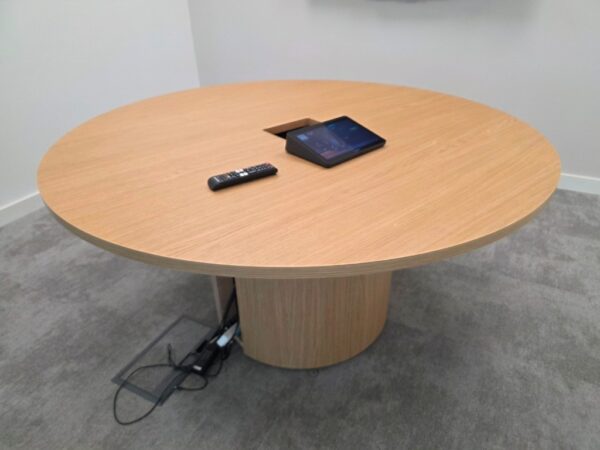
A round meeting table is measured by its diameter. The curved edge provides no corners, but the usable surface narrows towards the sides of each place.
Square meeting tables
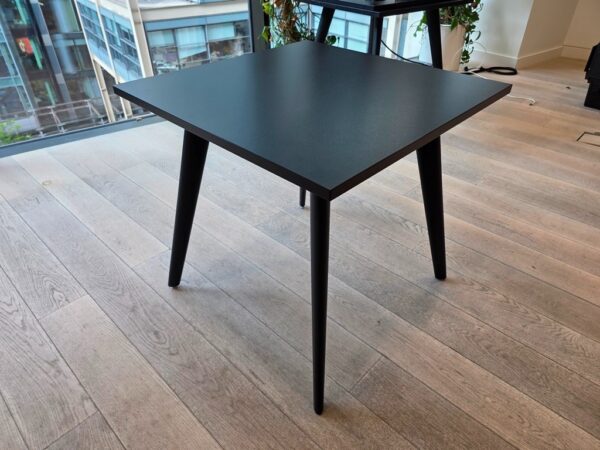
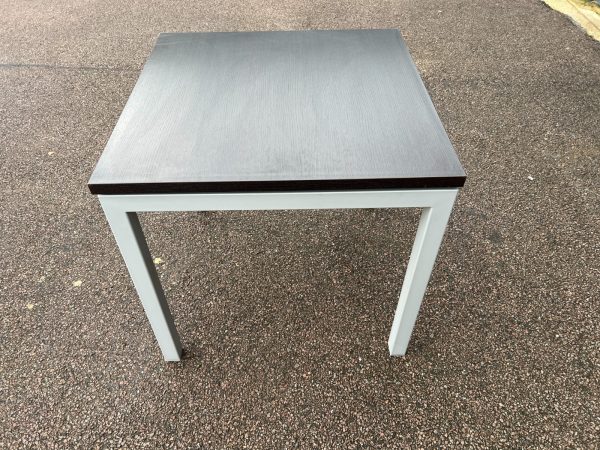
A square meeting table has equal-length sides and corner surface beyond a circle of the same width. Its legs and corners may affect seating and movement.
Side by side
Round vs square meeting tables
| Decision | Round meeting tables | Square meeting tables |
|---|---|---|
| Edge | Continuous curved edge | Four straight sides with corners |
| Equal-width surface | Less tabletop area | More tabletop area including corners |
| Seating positions | Can be arranged around the circumference | Often arranged along the sides |
| Alignment | Does not sit flush edge-to-edge | Straight sides can align with other surfaces |
| Room movement | No projecting tabletop corners | Corner positions need checking |
| Joining tables | Usually leaves gaps between tops | Possible only where dimensions and bases suit |
Worked measurement
Equal width is not equal surface area
Illustrative geometry for a 1,000 mm-wide square and a circle of 1,000 mm diameter.
| Check | Option or calculation | What it tells you |
|---|---|---|
| Square top | 1.0 × 1.0 | 1.00 m² |
| Round top | π × 0.5 × 0.5 | About 0.79 m² |
| Difference | About 0.21 m² | Extra corner area, not an extra guaranteed seat |
The square provides more tabletop in those corners. That may help with papers or devices, but it does not establish a larger comfortable seating capacity. Base position, chair width and where the legs go still need checking.
If combining small square tables, verify finished heights and edges as well as dimensions. Tables that touch on a plan may have incompatible bases or leave an awkward joint. A larger single table may be easier if the combined layout will remain in place.
The details that change the decision
Same width does not mean the same amount of table
Take an illustrative 1,000 mm square and a 1,000 mm diameter circle. The square has 1.00 square metre of top; the circle has about 0.79 square metre. This is geometry, not a seating-capacity recommendation.
The extra area sits at the square’s corners. It may be useful for documents or equipment, but it does not automatically create additional comfortable seats. Compare a real place setting with the laptop, notebook and chair you expect to use.
Check the base where the knees will be
A pedestal base can leave the edge relatively clear while placing a broad foot near people’s feet. Four legs can put an obstruction close to the corners. Neither arrangement is automatically better; inspect where each person will sit.
Square tables can look easy to push together, but the resulting leg positions or gaps may make the joined arrangement awkward. Ask whether the product is designed for linking and whether compatible connectors are available. Do not assume matching top dimensions are enough.
Small meeting corners still need a route past them
In an open office, allow for someone joining or leaving the table while colleagues remain seated. The occupied area is larger than the furniture’s resting footprint. Check nearby cupboards and desk chairs too.
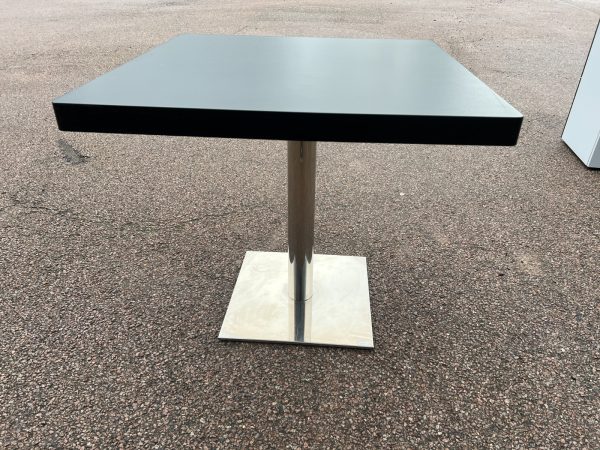
For a used table, inspect the edges, corners, base connections and surface condition in good light. A square top has corners to assess; a round top still needs a complete edge check. Confirm measurements from the seller rather than judging scale from a room photograph.
Put it in a real room
Four colleagues, laptops and a sample tray
The square’s corners may give the sample tray somewhere to sit, while the round table may make it easier to turn towards one another. Lay out the actual objects before choosing. If the tray occupies the central reach zone on either table, a nearby side surface could be more useful than increasing the meeting table until it overwhelms the room.
Before ordering
Five checks worth doing
- 01Compare actual dimensions rather than shape names.
- 02Lay out the devices and materials used in a normal meeting.
- 03Check base and leg positions for each intended seat.
- 04Include the route past occupied chairs.
- 05Confirm linking compatibility if tables will be combined.
Clear answers
Frequently asked questions
Does a square table have more surface at the same width?
Yes, compared with a circle whose diameter equals that width. Whether the extra corner area is useful depends on the task.
Can two square tables become one meeting table?
Sometimes. Check heights, edges, bases and any required linking hardware.
Is a round table always better for four people?
No. Diameter, chair size, legroom and the room layout matter more than a fixed headcount rule.
Ready to compare real options?
Take the brief to current stock.
Compare current tables with your chairs, room layout and presentation requirements. Condition, quantity, price and delivery can change, so verify the current listing and order details.