Comparison guide · Meeting & collaboration · 03
Round vs rectangular meeting tables: start with the room, not the chair count
The table fits on the floor plan. Then the chairs arrive, someone opens the door and the room suddenly feels smaller. Shape matters most when the whole meeting is drawn in.
Get the short answer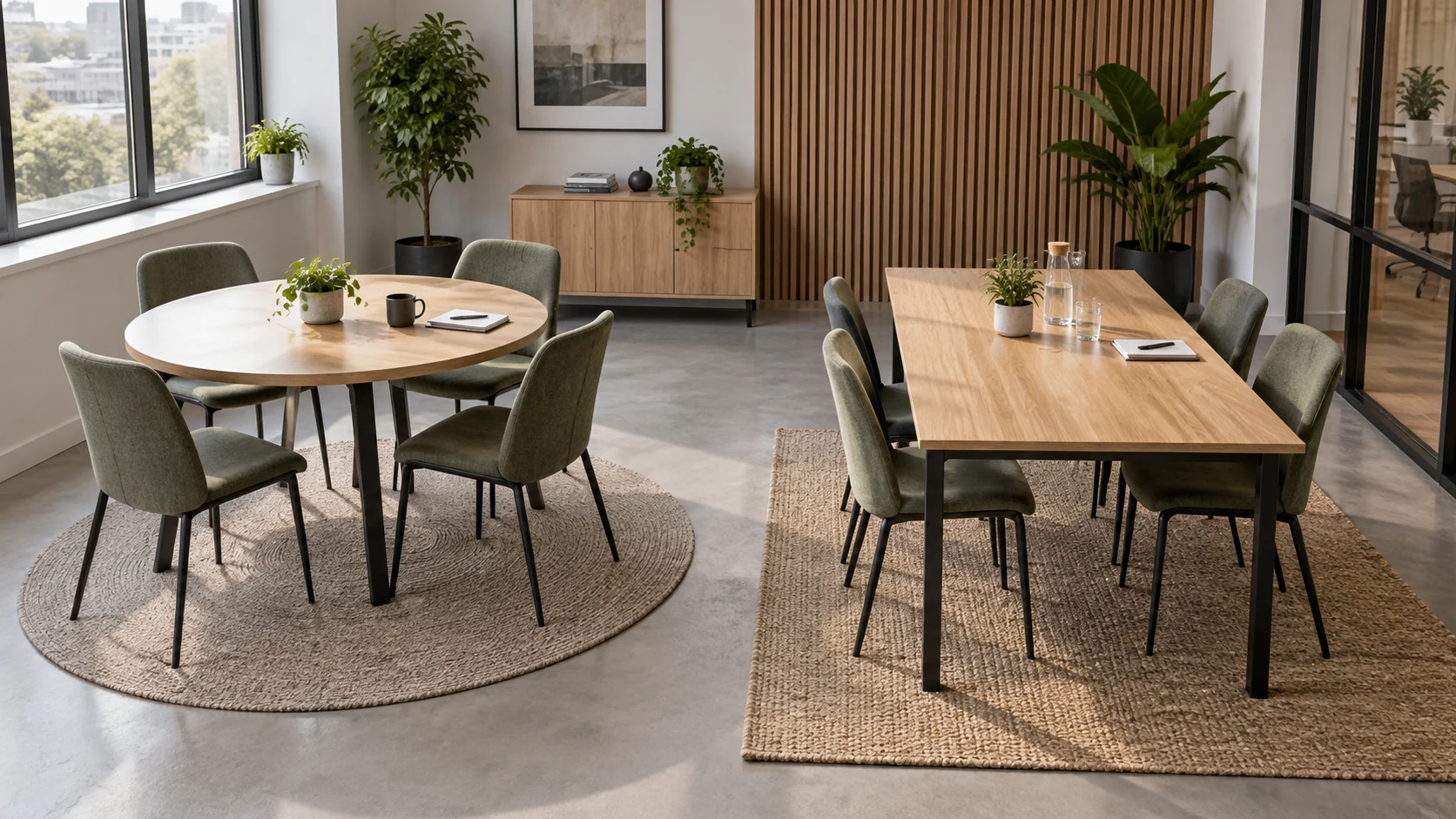
Short answer
A round table often suits a small discussion group without a fixed front. A rectangular table can suit a longer room, a larger group or a clear presentation direction. Neither shape automatically saves space: compare the occupied footprint, table base and routes around the actual furniture.
Choose on purpose
Which option fits which situation?
Choose round for a small conversation group when a continuous edge and no fixed head position help the meeting.
Choose rectangular when a longer room, larger group or presentation direction makes the arrangement more practical.
Side by side
Round vs rectangular meeting tables
| Decision | Round meeting tables | Rectangular meeting tables |
|---|---|---|
| Conversation | No obvious head of the table | Can establish a clear front or host position |
| Room shape | Often worth testing in squarer spaces | Often easier to align in longer spaces |
| Screen viewing | Some seats may face away from the screen | A presentation direction is easier to establish |
| Shared materials | Central reach needs checking as size grows | Depth matters for reaching across |
| Seating | Diameter and base govern practical positions | Length, ends and legs govern practical positions |
| Room clearance | Allow chairs and movement around the circle | Allow chairs along sides and at the ends |
Know what is being compared
Round meeting tables
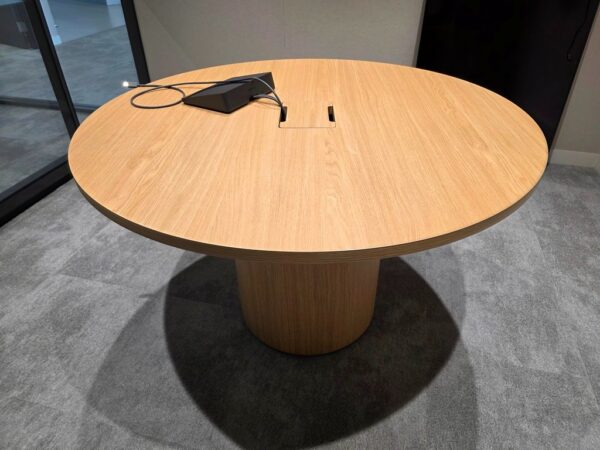
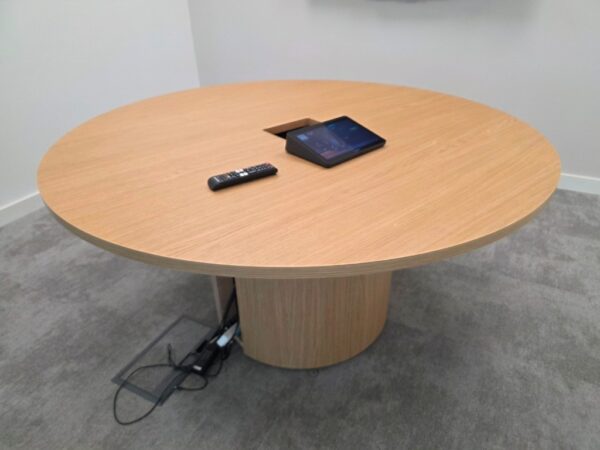
A round table has a circular top, creating similar positions around its edge. Its diameter is only the starting point for the room layout.
Rectangular meeting tables
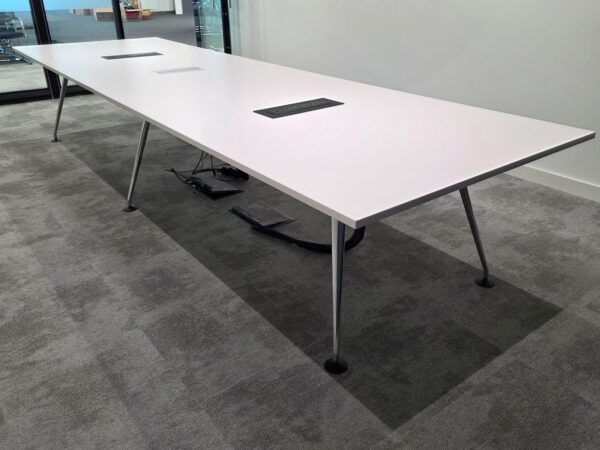
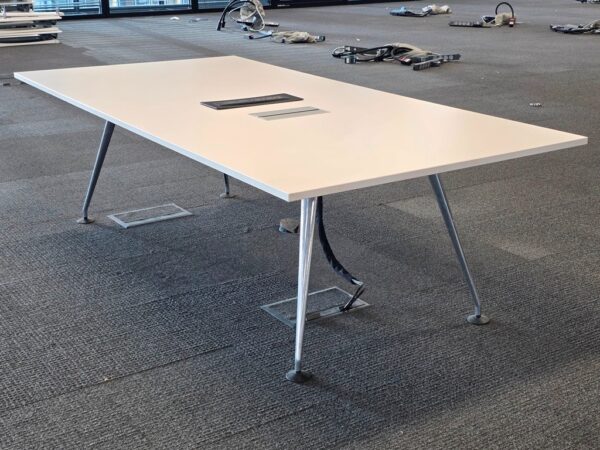
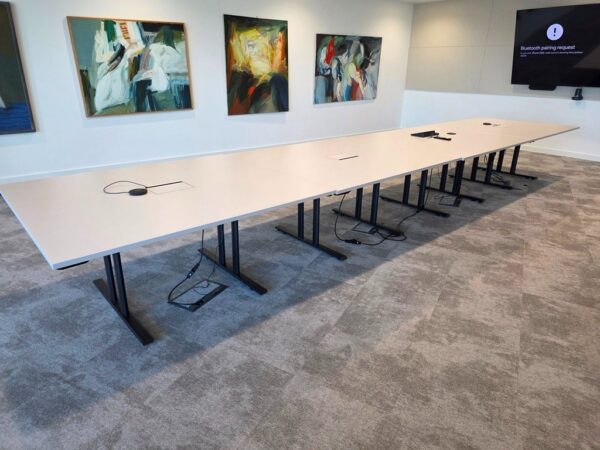
A rectangular table has long and short sides, which can align with a room or a presentation wall. Base placement and end seating affect usable capacity.
Practical example
Put both shapes into the same room drawing
Illustrative table sizes: a 1,200 mm-diameter circle and a 1,600 × 800 mm rectangle.
| Check | Option or calculation | What it tells you |
|---|---|---|
| Bare tabletop area | Round: about 1.13 m² | Rectangle: 1.28 m² |
| Bounding dimensions | 1,200 × 1,200 mm | 1,600 × 800 mm |
| The decision still needs | Chairs, base and circulation | Screen views and occupied seating positions |
The round top has less area in this example but takes more depth in its bounding rectangle. Neither fact identifies the better room layout on its own. Add the chairs pulled into their working positions and show the route someone uses while the meeting is underway.
Test the presentation direction as well as conversation. A round layout can suit face-to-face discussion, yet some seats may face away from a wall-mounted screen. A rectangular table can establish a front, but its long sides may still leave difficult viewing angles.
Put it in a real room
A small room with one screen and one awkward door
Start by drawing the door swing and the seats that need a clear view of the screen. Test a round table and a short rectangle at their real dimensions. The round version may work for conversation but place a chair in the doorway; the rectangle may preserve the route but lose an end seat. The better layout is the one that works while occupied, even if its advertised capacity is lower.
The details that change the decision
A rounded edge is not a smaller occupied footprint
The missing corners of a round top can soften movement past the table, but chairs still extend beyond it. Compare the table plus occupied chairs, not the tabletop outlines alone. A chair pulled back near a door can become the deciding measurement.
For a rectangular table, a long side may fit neatly along the room’s main axis. However, squeezing the ends towards a wall can make end seats unusable. Draw the arrangement that people will actually use rather than the maximum seats shown in a product photograph.
Conversation and presentations ask for different views
A small round table can work well when everyone mainly looks at one another. Once the meeting depends on a wall-mounted screen, some participants may need to turn repeatedly. Check that arrangement with the intended chairs.
A rectangle can give the room a clearer presentation direction, but the longest table is not always the best for hybrid calls. Test the camera view and the screen from the furthest seat. Choose dimensions and equipment together.
Look underneath before deciding how many seats fit
A central base and four corner legs create different legroom. Broad feet, crossbars and cable housings can occupy positions that appear usable from above. Measure the chair width and the clear space at each intended seat.
When buying used, check that the top and base belong together and that the correct fixings are present. Inspect the underside and the stability of the assembled table. Shape tells you little about the condition of its connections.
Before ordering
Five checks worth doing
- 01Measure the room, door swing and fixed equipment.
- 02Mark occupied chairs and routes around them.
- 03Check views of the screen and camera from every seat.
- 04Inspect table bases, crossbars and fixing points.
- 05Verify capacity using the actual chairs and meeting tasks.
Clear answers
Frequently asked questions
Does a round table take up less space?
Not always. Compare diameter, chairs and circulation with the specific rectangular alternative.
Are rectangular tables only for formal meetings?
No. They can support informal discussions, workshops and everyday team meetings.
Can I work out capacity from the tabletop alone?
Only roughly. Chair widths, legroom, equipment and the room itself can reduce practical capacity.
Ready to compare real options?
Take the brief to current stock.
Compare current tables with your chairs, room layout and presentation requirements. Condition, quantity, price and delivery can change, so verify the current listing and order details.