Comparison guide · Storage & filing · 06
Lateral vs vertical filing cabinets: compare the room with the drawers open
A narrow cabinet can consume more space in front than expected. A wide cabinet can organise files neatly but use wall space you need for something else. Compare them in use, not closed.
Get the short answer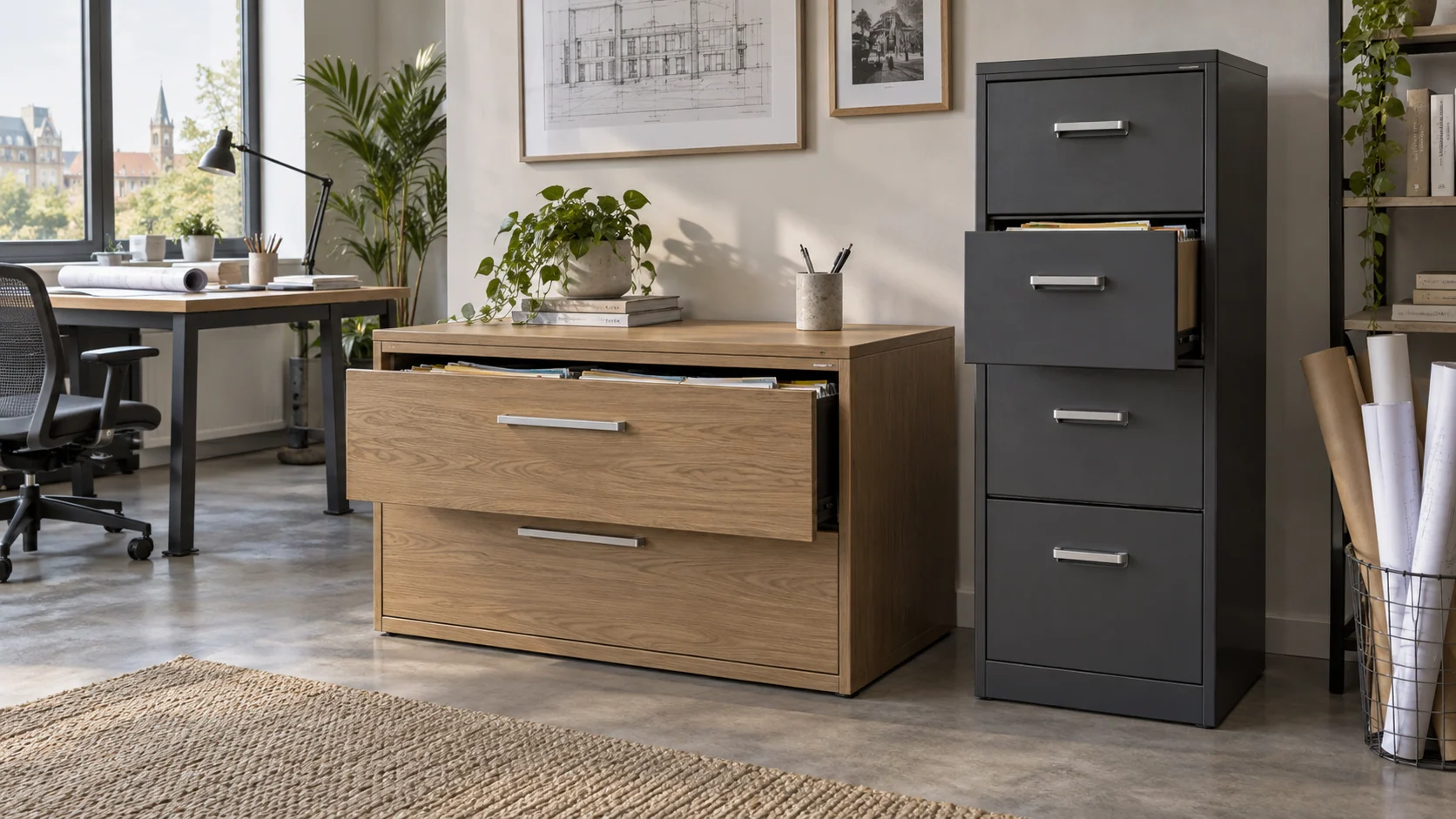
Short answer
Lateral cabinets generally spread filing across a wider unit, while vertical cabinets use a narrower, deeper arrangement. The best fit depends on wall width, drawer projection and the actual internal filing layout. Neither format is automatically the higher-capacity option.
Choose on purpose
Which option fits which situation?
Choose a lateral arrangement when its wider format and filing orientation suit the wall and the documents.
Choose a vertical arrangement when the narrower frontage is useful and the drawer can open fully without obstructing use.
Side by side
Lateral vs vertical filing cabinets
| Decision | Lateral filing cabinets | Vertical filing cabinets |
|---|---|---|
| Typical shape | Wider and relatively shallower | Narrower and relatively deeper |
| Wall space | Uses more frontage | Uses less frontage per cabinet |
| Drawer projection | Check the actual extension | Check the actual extension |
| Filing orientation | May support several rail arrangements | Commonly front-to-back filing |
| Capacity | Compare usable filing runs | Compare usable filing runs |
| Placement | Useful where wall width is available | Useful where a narrow frontage is valuable |
Practical example
Compare the cabinet with the drawer open
Illustrative comparison only: add the closed depth and the actual drawer projection for each candidate, then allow room for the user.
| Check | Option or calculation | What it tells you |
|---|---|---|
| Candidate A | 500 mm closed depth + 400 mm projection | 900 mm before user space |
| Candidate B | 620 mm closed depth + 500 mm projection | 1,120 mm before user space |
| Do not omit | The width occupied along the wall | The person, adjacent furniture and route |
These figures show a method, not typical dimensions for all lateral or vertical cabinets. Measure the exact offers. A smaller depth with the drawer shut can cease to be an advantage if the open drawer blocks the only route past a desk.
Next compare usable filing length in the required folder format. Two wide drawers and four narrow drawers cannot be ranked on drawer count alone. Check rails, stops and the intended installation arrangement, and do not assume several drawers can safely remain open together.
A practical route to a decision
Record the room, route and working clearances.
List what the users and the task actually require.
Compare the condition and completeness of the real options.
Know what is being compared
Lateral filing cabinets
A lateral filing cabinet is generally wide relative to its depth, with filing commonly arranged across the drawer. Some models support alternative internal orientations.
Vertical filing cabinets
A vertical filing cabinet generally uses a narrower frontage and deeper drawers, commonly with files arranged front to back. Exact dimensions and compatible folders vary.
The details that change the decision
The open drawer belongs on the floor plan
Measure the cabinet depth and the drawer at full extension. Add the space needed to retrieve files and the route used by other people. The useful operating footprint is not just the rectangle beneath the closed cabinet.
This matters behind desks and beside circulation routes. A cabinet can be compact when shut and obstructive when a person is filing. Compare both formats using the same room and the same access assumptions.
Count usable filing length, not drawers alone
Four drawers do not necessarily hold more than two wider drawers. Compare the usable runs of compatible suspension files in the actual configuration. Include the space occupied by rails, followers and other fittings.
For an illustrative calculation, two usable runs of 700 mm provide 1,400 mm of filing length before allowing for practical handling and contents. That is a method, not a specification for any cabinet. Measure the supplied unit and your filled folders rather than converting drawer count into a capacity claim.
Access height and installation still matter
A tall narrow cabinet may put some records above the most convenient working level. A lower lateral unit may spread them across more wall space. Consider who uses the files and which drawers will contain the most frequently accessed records.
Inspect drawer runners, locks, interlocks where fitted and the cabinet’s stability. Follow manufacturer loading and installation instructions, including any fixing requirements. A low unit is not automatically safe to overload, and a tall unit should not be judged by appearance alone.
Put it in a real room
A wide wall beside a busy corridor
A lower lateral cabinet may be worth considering if it provides the required filing while keeping the operating arrangement away from the busiest route. But its width may conflict with a door or other storage. Draw the actual cabinet and open drawers for both options. The winner is the arrangement that holds the records and lets the office keep working.
Before ordering
Five checks worth doing
- 01Measure wall width, cabinet depth and full drawer extension.
- 02Confirm filing format and the number of usable internal runs.
- 03Check access to the most frequently used records.
- 04Test drawers, locks and any interlock mechanism.
- 05Confirm loading, fixing and delivery requirements.
Clear answers
Frequently asked questions
Do lateral cabinets always hold more files?
No. Capacity depends on the dimensions and internal layout of the particular cabinet. Compare usable filing length.
Are vertical cabinets better for small offices?
They use less wall frontage, but their depth and open drawers may not suit a tight route. Test the operating footprint.
Can lateral filing run front to back?
Some systems support alternative orientations with compatible fittings. Confirm the exact arrangement and included accessories.
Useful source material
Ready to compare real options?
Take the brief to current stock.
Use your contents list and internal measurements to narrow down current storage options. Condition, quantity, price and delivery can change, so verify the current listing and order details.