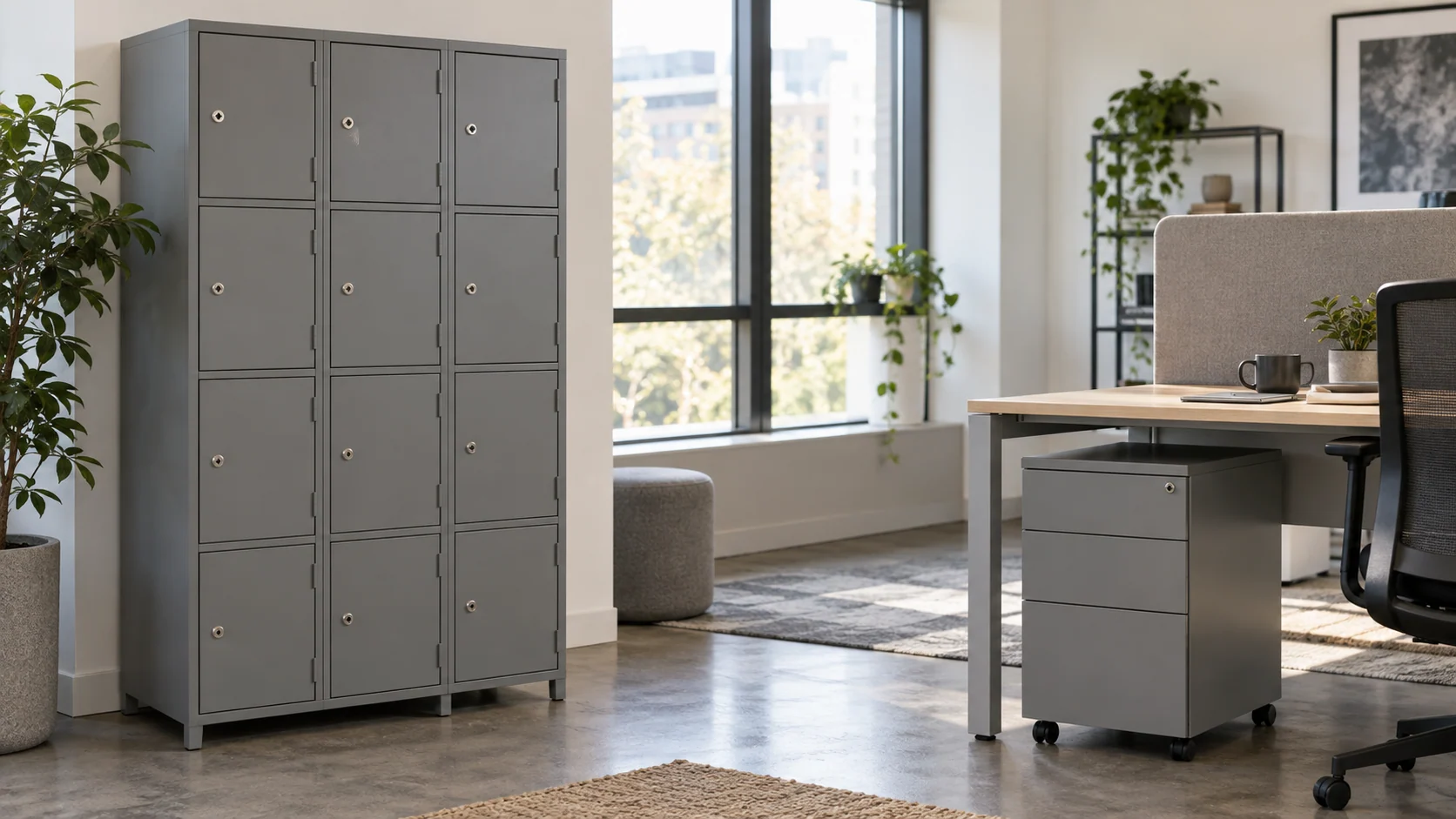
Comparison guide · Storage & filing · 02
Office lockers vs pedestal cabinets: storage for the person or the desk?
When people no longer use the same desk every day, desk-side storage can become a surprisingly fixed part of an otherwise flexible office.
Get the short answerShort answer
Office lockers can separate personal storage from an assigned workstation. Pedestal cabinets keep frequently used items beside the desk. Choose according to where belongings need to live and how often staff change positions, rather than treating both as interchangeable small cabinets.
Choose on purpose
Which option fits which situation?
Choose lockers when personal belongings need a place independent of the desk a person uses that day.
Choose pedestals for items needed repeatedly beside a dedicated workstation, with enough legroom left for its user.
A practical route to a decision
Record the room, route and working clearances.
List what the users and the task actually require.
Compare the condition and completeness of the real options.
Put it in a real room
Twenty staff use twelve shared desks
Buying twelve pedestals may leave eight people without a clear place for belongings, while permanently assigning those pedestals could undermine the shared-desk arrangement. A suitably planned locker provision may fit better. However, a small amount of shared desk-side storage could still serve stationery and working materials. Count people, attendance patterns and contents separately.
Worked measurement
Twenty staff and twelve desks are two different counts
Illustrative hybrid-office brief: twenty staff share twelve desks. Storage depends on allocation, not just the desk total.
| Check | Option or calculation | What it tells you |
|---|---|---|
| Permanent personal allocation | Twenty people may need twenty assigned spaces | Twelve desk drawers do not cover that allocation |
| Daily-use allocation | Size for actual attendance and storage demand | Include a clear emptying and access procedure |
| Shared stationery | A small shared supply point may be enough | Not every item needs personal storage |
Before choosing a lock type, decide who owns a compartment and for how long. Permanent allocation, day-use lockers and team storage create different operating needs. A combination lock does not remove the need for reset instructions and a way to manage forgotten codes.
Check the bag, laptop case or helmet against the clear internal opening. The outside height of a locker bank tells you little about an individual compartment. A pedestal may be convenient for papers yet unsuitable for the belongings that prompted the purchase.
Side by side
Office lockers vs pedestal cabinets
| Decision | Office lockers | Pedestal cabinets |
|---|---|---|
| Location | Usually a shared storage zone | At or beneath a workstation |
| Best fit | Personal items independent of desk allocation | Items needed repeatedly during desk work |
| Capacity | Check compartment height, width and depth | Check drawer sizes and filing provision |
| Movement | People visit the storage area | Items remain close to the desk |
| Management | Assignment and access policy matter | Ownership can follow an assigned desk |
| Used checks | Doors, locks, keys and complete compartments | Drawers, castors, locks and desktop clearance |
Know what is being compared
Office lockers
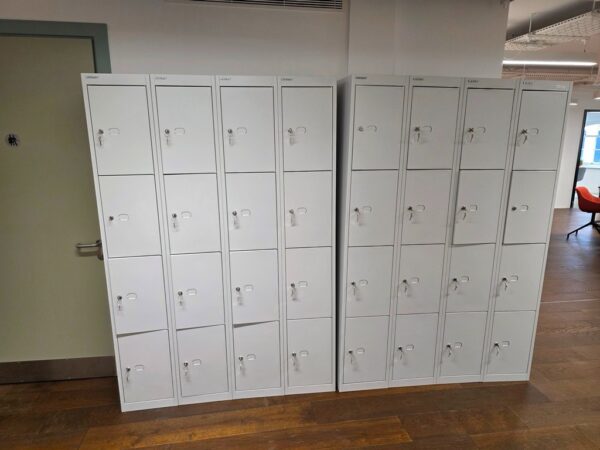
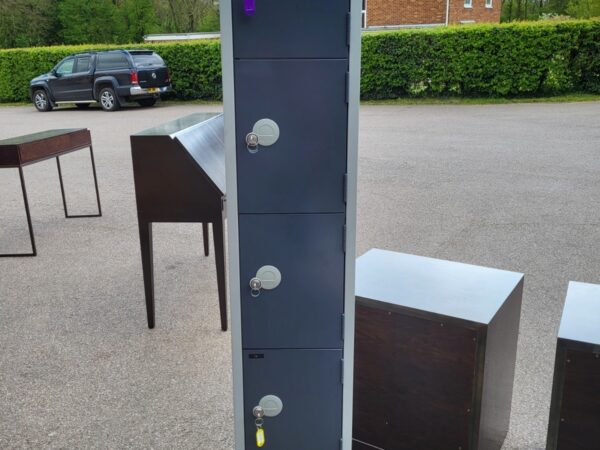
Office lockers provide individual compartments, often grouped in a shared location. Assignment, lock type and compartment size determine how the system works.
Pedestal cabinets
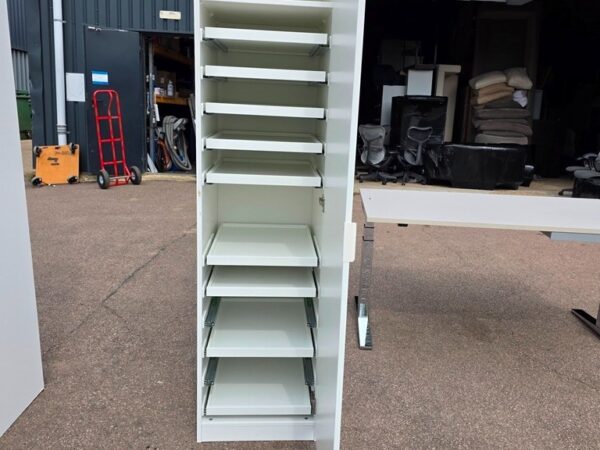
Pedestal cabinets are compact drawer units positioned beside or beneath desks. They may be mobile, freestanding or attached to the desk structure.
The details that change the decision
Shared desks change the storage question
If a person uses different workstations, leaving their belongings in one pedestal can make that desk feel reserved. Lockers can help separate personal storage from the day’s chosen workspace. That only works when the lockers are convenient and staff understand how they are allocated.
For people who use the same workstation and need paper files or tools throughout the day, desk-side drawers may still be useful. Requiring repeated walks to a locker is not automatically a better arrangement simply because the office uses shared desks elsewhere.
A compartment needs to fit the actual belongings
A laptop bag, coat, helmet and pair of shoes create a different requirement from a notebook and charger. Ask for clear internal dimensions, not only the overall locker-bank size. Shelves and door hardware can reduce the useful opening.
Likewise, check pedestal drawers with the items they will hold. A shallow stationery drawer is not useful laptop storage just because the cabinet sits under a desk. Do not charge devices inside enclosed storage unless it is designed and specified for that purpose.
Keys and allocation are operational decisions
Decide whether compartments are permanently assigned, booked or cleared daily. Then choose an access arrangement that staff can actually manage. A large bank of lockers with missing keys or unknown reset procedures can create more administration than it removes.
For used lockers, confirm every door operates and that the supplied locks match your intended management method. Ask about replacement keys, master access where appropriate and any code-reset instructions. Assess security against the contents rather than assuming any lock is sufficient.
Before ordering
Five checks worth doing
- 01Decide whether storage belongs to a person, team or desk.
- 02Measure typical bags and other belongings.
- 03Confirm usable compartment or drawer dimensions.
- 04Test every door, drawer and supplied lock.
- 05Plan allocation, replacement keys and day-to-day access.
Clear answers
Frequently asked questions
Are lockers only for changing rooms?
No. Office lockers can store everyday personal belongings, provided their size and specification suit the use.
Can mobile pedestals support shared desks?
They can in a planned system, but consider where they are parked, who uses them and whether moving them creates obstructions.
Should I choose electronic locks?
Not automatically. Compare management, maintenance, reset procedures and user needs with simpler key or combination options.
Ready to compare real options?
Take the brief to current stock.
Use your contents list and internal measurements to narrow down current storage options. Condition, quantity, price and delivery can change, so verify the current listing and order details.