Comparison guide · Desks & workstations · 01
Bench desks vs individual desks: plan for the team you actually have
A neat row of desks can make a room look organised. The harder question is whether it will still work when one team grows, somebody needs a different position or the office moves again.
Get the short answer
Short answer
Bench desks make sense when several people can share a planned layout and common infrastructure. Individual desks suit rooms that need independent positions or frequent changes. Compare the complete installed arrangement, not just the price of one desktop.
Choose on purpose
Which option fits which situation?
Choose a bench system for a settled team layout when the complete frame, cable management and future extension parts are available.
Choose independent desks when positions will move separately, room shapes differ or the team needs different workstation sizes.
Know what is being compared
Bench desks
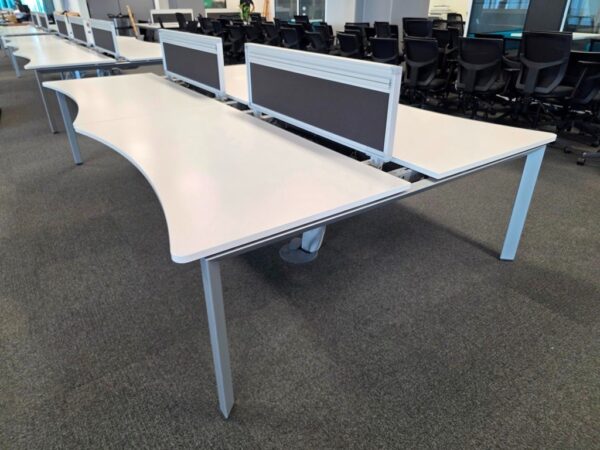
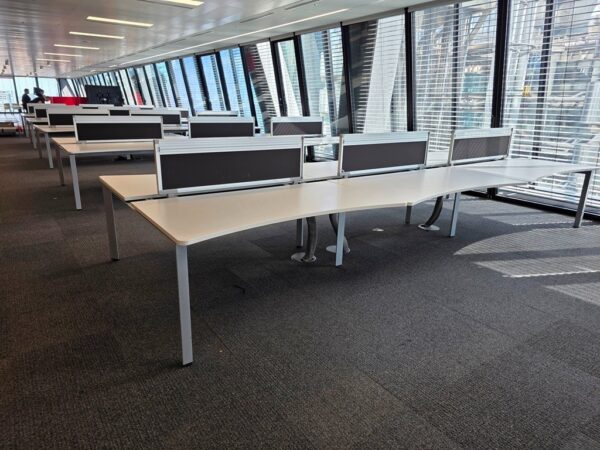
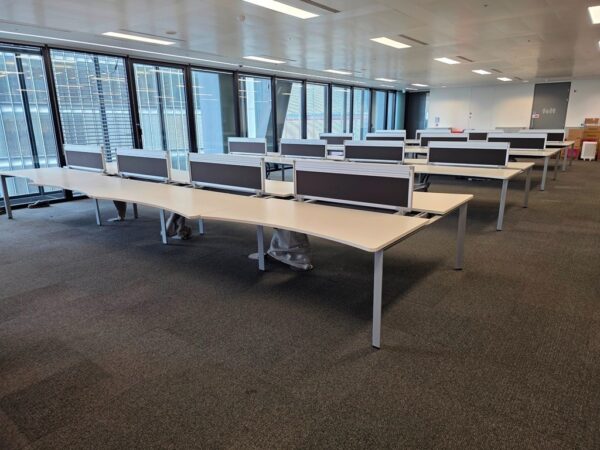
A bench system groups workstations into a coordinated run or island. Some share frames and intermediate legs; others are separate desks supplied as a linked system. Ask which construction you are buying.
Individual desks
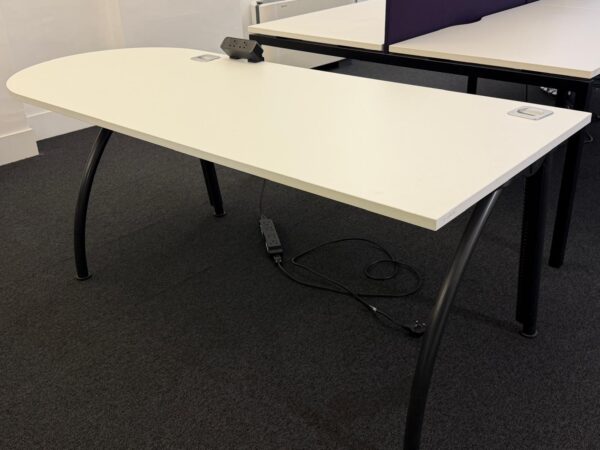
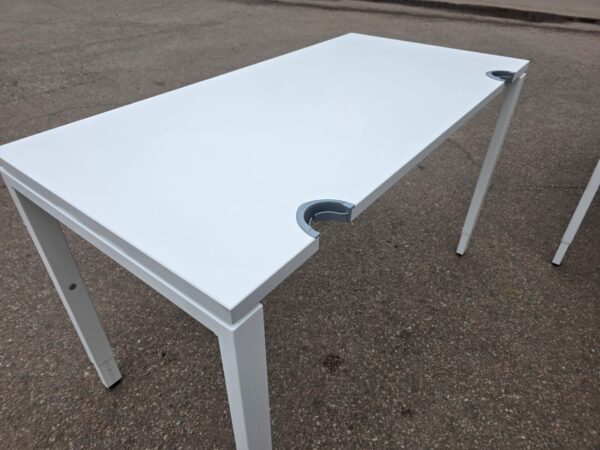
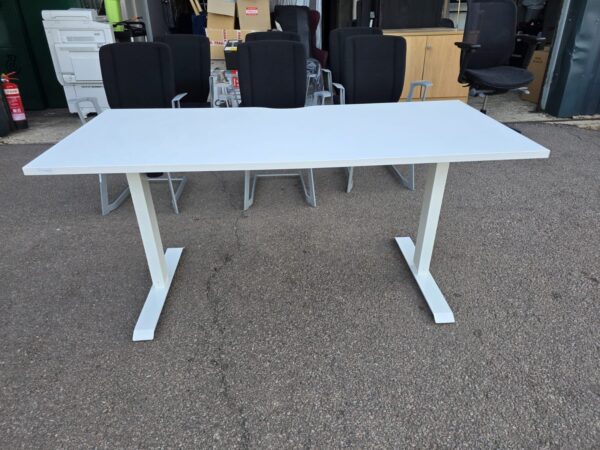
An individual desk has its own supporting structure and can normally stand on its own. Several can still form a row, but each position remains a complete piece of furniture.
Side by side
Bench desks vs individual desks
| Decision | Bench desks | Individual desks |
|---|---|---|
| Layout | Consistent rows and islands | Independent placement around the room |
| Reconfiguration | May need extra end legs or brackets | Usually easier to relocate one position |
| Cable routes | Shared trays may consolidate equipment | Each position needs a workable cable route |
| Mixed users | Check whether individual heights or positions can vary | Different desks can suit different requirements |
| Used purchase | Count shared components, not only tops | Check every desk is structurally complete |
| Total cost | Include assembly and future conversion parts | Include separate accessories and installation |
Practical example
Four positions: count the complete system
Illustrative layout, not a minimum-space standard: four 1,400 × 700 mm tops can be arranged in two facing pairs.
| Check | Option or calculation | What it tells you |
|---|---|---|
| Bare top envelope | 2,800 × 1,400 mm in this arrangement | The same, if identical tops are arranged identically |
| What the drawing leaves out | End frames, screens and shared fittings | Separate frames and accessories |
| Next change | Check parts needed to split the bench | Each complete desk can move independently |
The bare desktop rectangle is 3.92 m² in either example. A shared frame does not, on its own, prove that a bench uses less room. Add the actual chairs, entry space, circulation, screens and storage to both drawings before comparing the occupied area.
A second-hand bench quote should count complete usable positions, not just tabletops. Ask which end supports, intermediate supports, joining parts and cable trays are supplied. For a growing team, price an extra position and any conversion components separately.
The details that change the decision
Shared desks do not automatically mean a smaller office
The useful comparison is a complete floor plan with the same number of working positions. Include chairs in use, routes to doors, storage access and the places where people stop to talk. A shared frame can reduce duplicate legs, but it does not remove the need for each person to work comfortably.
Avoid comparing a tightly packed bench drawing with a generously spaced individual-desk drawing. That rewards the drawing rather than the furniture. Use the same assumptions on both plans, including screens, monitor arms and the space needed to enter each workstation.
The expensive part can be the next change
Ask how the system becomes a different arrangement. A six-position bench may not split into three independent pairs without additional legs, beams or cable trays. Equally, a modular system with available parts may reconfigure very well. The answer is specific to the range.
With individual desks, a single workstation can often move without affecting the others. However, moving furniture is only part of the job. Power, network connections, shared screens and storage can keep an apparently independent desk tied to its old location.
Cabling needs a plan of its own
Count the equipment at each position before selecting trays. Consider power supplies, docking stations and monitor-arm clamps as well as visible cables. Shared containment is useful only when there is room for the equipment and access for maintenance.
Check what is included with used benches. A photograph may show a cable spine, screen brackets or power modules that are not part of the quoted set. Ask for an itemised list and confirmation of any electrical inspection or installation work required.
Put it in a real room
A team that may split into two rooms
Imagine buying for eight people who currently sit together, with a possible move to two rooms next year. Draw both layouts before choosing. A bench that divides into four complete two-person units may work well. A continuous eight-position frame with unavailable end components may not. The individual desks could cost more initially yet avoid a second furniture purchase. This is an illustrative planning example, not a quoted project.
Before ordering
Five checks worth doing
- 01Ask for the exact number of complete workstations, end legs, shared legs and connecting beams.
- 02Confirm the supplied screens, clamps, feet, trays and fixings.
- 03Check top edges, screw holes and frame connections for previous-move damage.
- 04Request the component sizes for delivery, not only the assembled dimensions.
- 05Compare delivery, assembly and any conversion parts on the same quotation.
Clear answers
Frequently asked questions
Are bench desks always cheaper?
No. A lower workstation price can be offset by missing components, assembly or changes to the office. Compare the complete delivered and usable arrangement.
Can bench desks be separated?
Sometimes. The construction and availability of end components determine whether each new section can stand safely. Get the proposed configuration confirmed before buying.
Can individual desks still look coordinated?
Yes. Matching heights, finishes and cable management can create a coherent layout without a shared frame.
Useful source material
Ready to compare real options?
Take the brief to current stock.
Compare the dimensions and components of current office desks against your room plan. Condition, quantity, price and delivery can change, so verify the current listing and order details.