Comparison guide · Meeting & collaboration · 05
Flip-top vs fixed meeting tables: how often will the room change?
A flexible meeting room needs somewhere to put its furniture between layouts. That is where a flip-top table can earn its place—and where an incomplete storage plan can undo the benefit.
Get the short answerShort answer
Flip-top tables suit rooms that are regularly cleared or rearranged, provided the folded tables have a safe storage position and the handling process works. Fixed tables suit layouts that mainly stay in place. Compare the complete changeover, not just the folding feature.
Choose on purpose
Which option fits which situation?
Choose flip-top when clearing or reconfiguring the room is frequent enough to justify the handling and storage plan.
Choose fixed when the room normally remains ready for the same activity and folding would add work without freeing useful space.
Put it in a real room
Training on Tuesday, an open floor on Wednesday
A room used for training and then a practical session is a good candidate for flip-top tables if they can be moved and stored properly. If the room hosts the same seated meeting every day, a fixed arrangement may be simpler. Compare the cost of flexibility with how often the team will actually use it.
Know what is being compared
Flip-top meeting tables
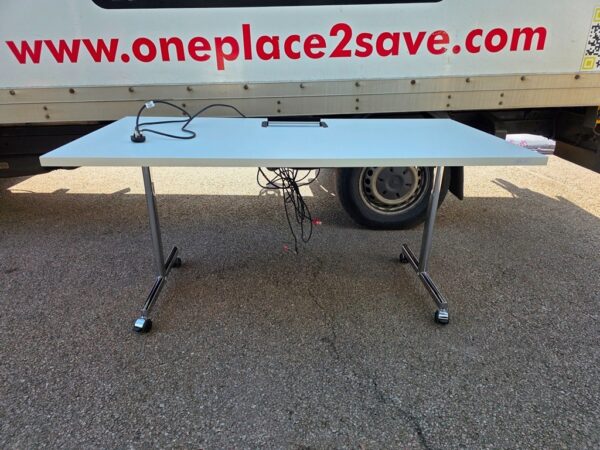
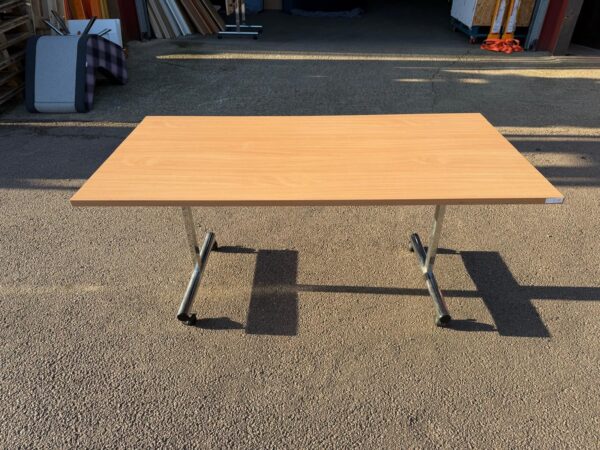
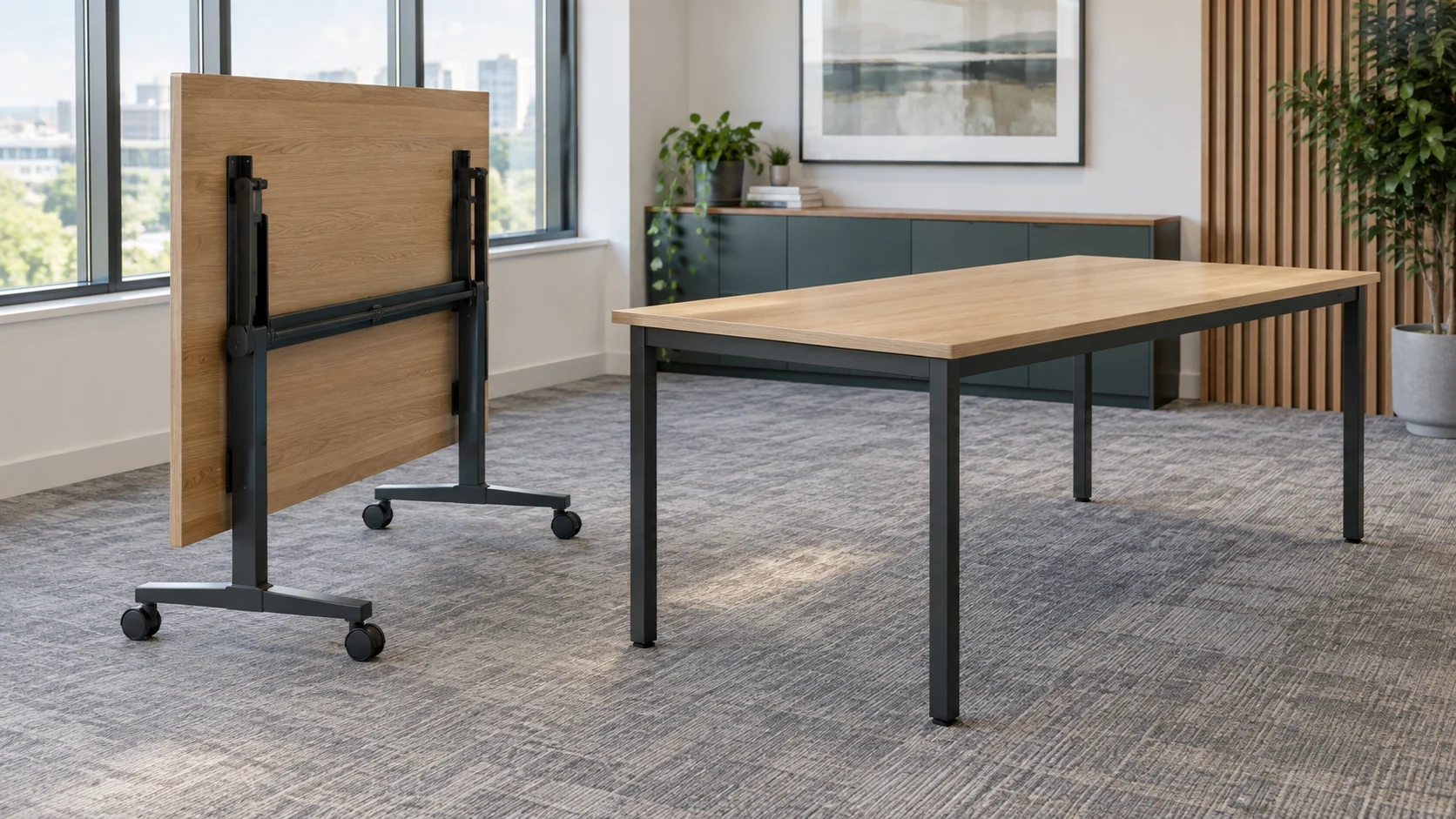
A flip-top table has a top that tilts for storage. Many models have castors and can nest, but the exact mechanism and stored dimensions vary.
Fixed meeting tables
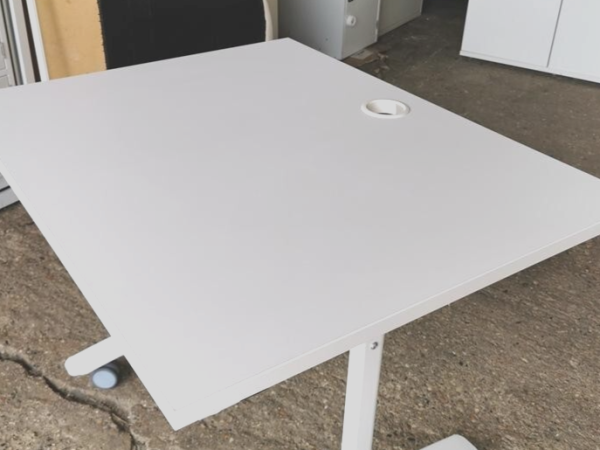
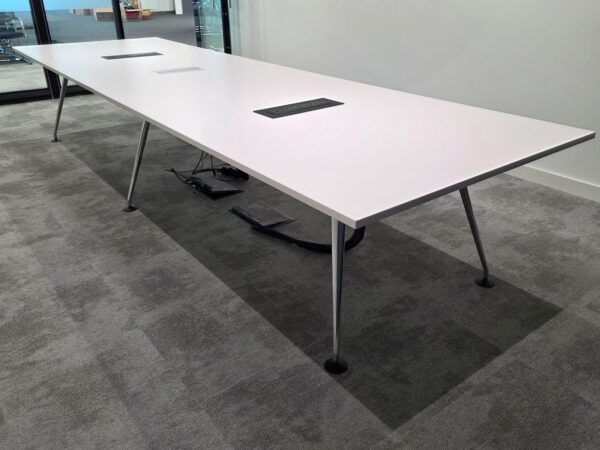
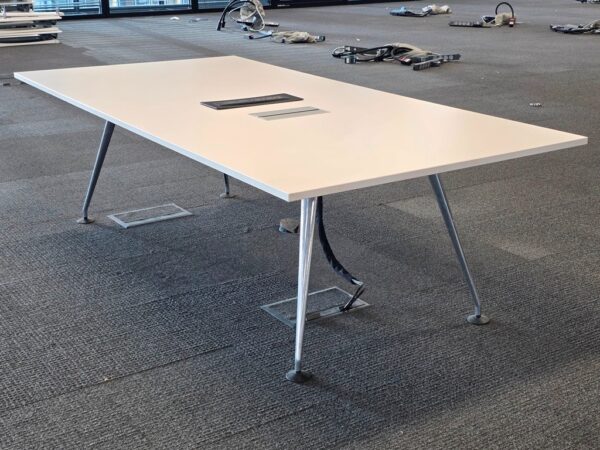
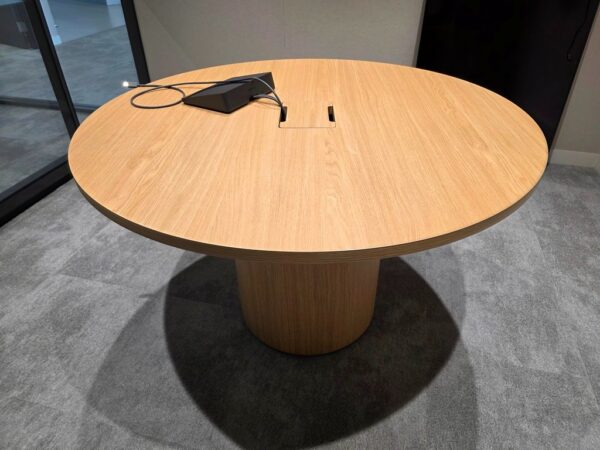
A fixed table keeps its top in the working position. It may still be movable or demountable; fixed does not always mean attached to the floor.
The details that change the decision
Measure the stored group, not one folded table
A folded table still has a base, a top thickness and space between it and the next unit. Ask for the manufacturer’s nesting dimensions or measure the actual group. Multiplying one tabletop thickness by the number of tables will not give a realistic storage footprint.
Check the route to storage, door widths and turning space. The storage area must not block exits or other required routes. If there is no suitable destination, folding the tops may simply move the problem to a corridor.
Include the time and people needed to reset the room
Walk through clearing objects, disconnecting equipment, releasing mechanisms, moving tables and arranging chairs. Follow the model’s handling instructions and use the appropriate number of people. A short demonstration can reveal more than a feature list.
For frequent changes, mark or document the layouts so the room returns to a useful arrangement. If one heavy screen or a fixed cable connection prevents most of the tables moving, reconsider whether the whole room needs flip-top furniture.
Used folding hardware deserves a proper demonstration
Ask to see each mechanism operate and lock correctly. Check castors, brakes where fitted, frame connections and the top’s condition around its fixings. Missing release or locking parts should not be treated as a cosmetic defect.
A fixed table is not automatically more stable, and a flip-top table is not automatically less stable. Inspect the actual construction and condition. For either type, obtain the appropriate operating and loading instructions rather than guessing what the surface can support.
Worked measurement
Nesting space is not one folded table multiplied by six
Illustrative storage calculation: suppose the first folded table occupies 700 mm of depth and each additional nested table adds 150 mm.
| Check | Option or calculation | What it tells you |
|---|---|---|
| First table | 700 mm | Starting depth |
| Five additional tables | 5 × 150 mm | 750 mm added |
| Six-table group | 700 + 750 | 1,450 mm total depth in this example |
Use the manufacturer’s actual folded and nesting measurements, including projections from feet and handles. The example assumes compatible tables designed to nest; it is not a permission to push unrelated tables together.
Also account for width, access to the stored group and the route used to move it. A table may fold neatly but still be inconvenient to manoeuvre through a doorway or around a tight turn. Compare the whole reset process with leaving a fixed table ready for use.
Side by side
Flip-top vs fixed meeting tables
| Decision | Flip-top meeting tables | Fixed meeting tables |
|---|---|---|
| Room changes | Designed to make regular rearrangement easier | Best when the layout rarely changes |
| Storage | Check folded dimensions and nesting spacing | Usually retains its tabletop footprint |
| Mechanisms | Hinges, release and locking parts need checking | Fewer folding parts to operate |
| Cables | Disconnect or manage before moving | Can support a more permanent cable arrangement |
| Setup | Requires a safe repeatable changeover | Often stays ready in one arrangement |
| Used inspection | Test locks, castors and top movement | Check frame, feet and top fixings |
Before ordering
Five checks worth doing
- 01Measure the full stored group and its access route.
- 02Ask for a demonstration of every release and lock.
- 03Inspect castors, brakes and frame connections.
- 04Plan cable disconnection and equipment storage.
- 05Confirm handling, loading and maintenance instructions.
Clear answers
Frequently asked questions
Do all flip-top tables nest together?
No. Nesting depends on the base and top design, and different models may not combine neatly.
Can a fixed table still be moved?
Often yes, using the appropriate handling method. Fixed normally describes the top or arrangement, not necessarily a floor fixing.
Are flip-top tables suitable for daily use?
They can be when the model is specified for that use and maintained correctly. Assess the product, not just the mechanism type.
Useful source material
Ready to compare real options?
Take the brief to current stock.
Compare current tables with your chairs, room layout and presentation requirements. Condition, quantity, price and delivery can change, so verify the current listing and order details.