



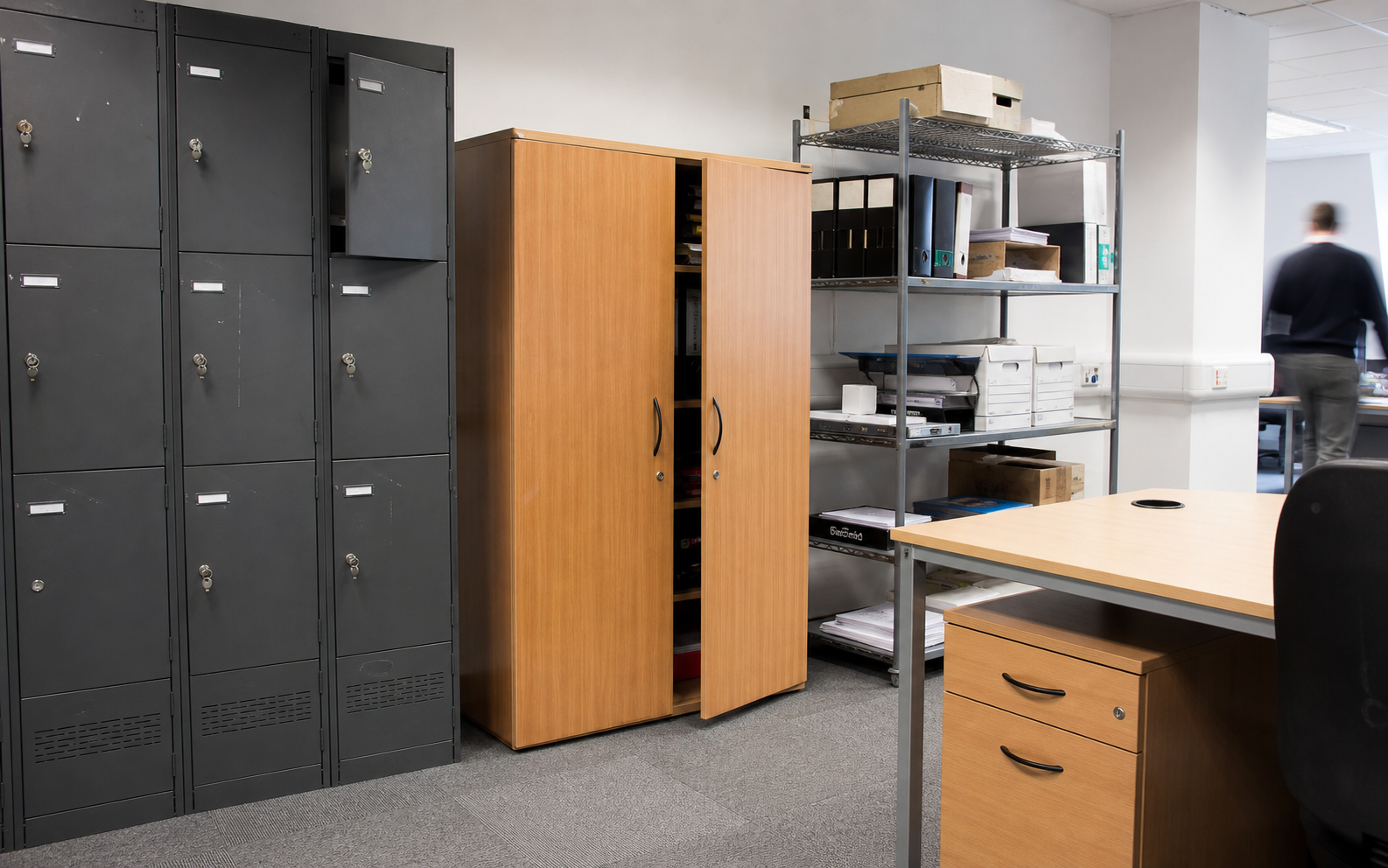
Inventory First. Furniture Second.
Buying a cupboard because a wall looks empty is how offices end up with storage that is full, awkward or in the wrong place. Begin with the things and the people.
Build a real storage inventory
Walk through the workplace and record what is already stored, what should be stored and what should be removed. Group items by physical size, user, access frequency and sensitivity. Photograph unusually shaped equipment and measure the largest items rather than relying on labels such as “office supplies”.
Then separate active storage from archive storage. Daily stationery belongs close to its users; historic files can sit farther away. Personal belongings need a different access model from shared consumables. Coats and wet umbrellas should not be planned as if they were clean paper stock.
The useful question is not “How many cabinets fit?” It is “What must be reached, protected and put away without disrupting work?”

01
Contents
Name the items, their quantity, dimensions, weight and whether they can share a compartment.
02
Ownership
Decide whether storage belongs to one person, a team, a room, facilities or the organisation.
03
Access rhythm
Place daily items in the easiest reach zone and move occasional stock away from prime floor area.
04
Control
Identify contents that need a key, code, audit trail or a more controlled room.
05
Growth
Allow for credible team or stock changes without buying large amounts of unusable air.
06
Removal
Clear duplicates, expired stock and material with a retention or disposal requirement before sizing.
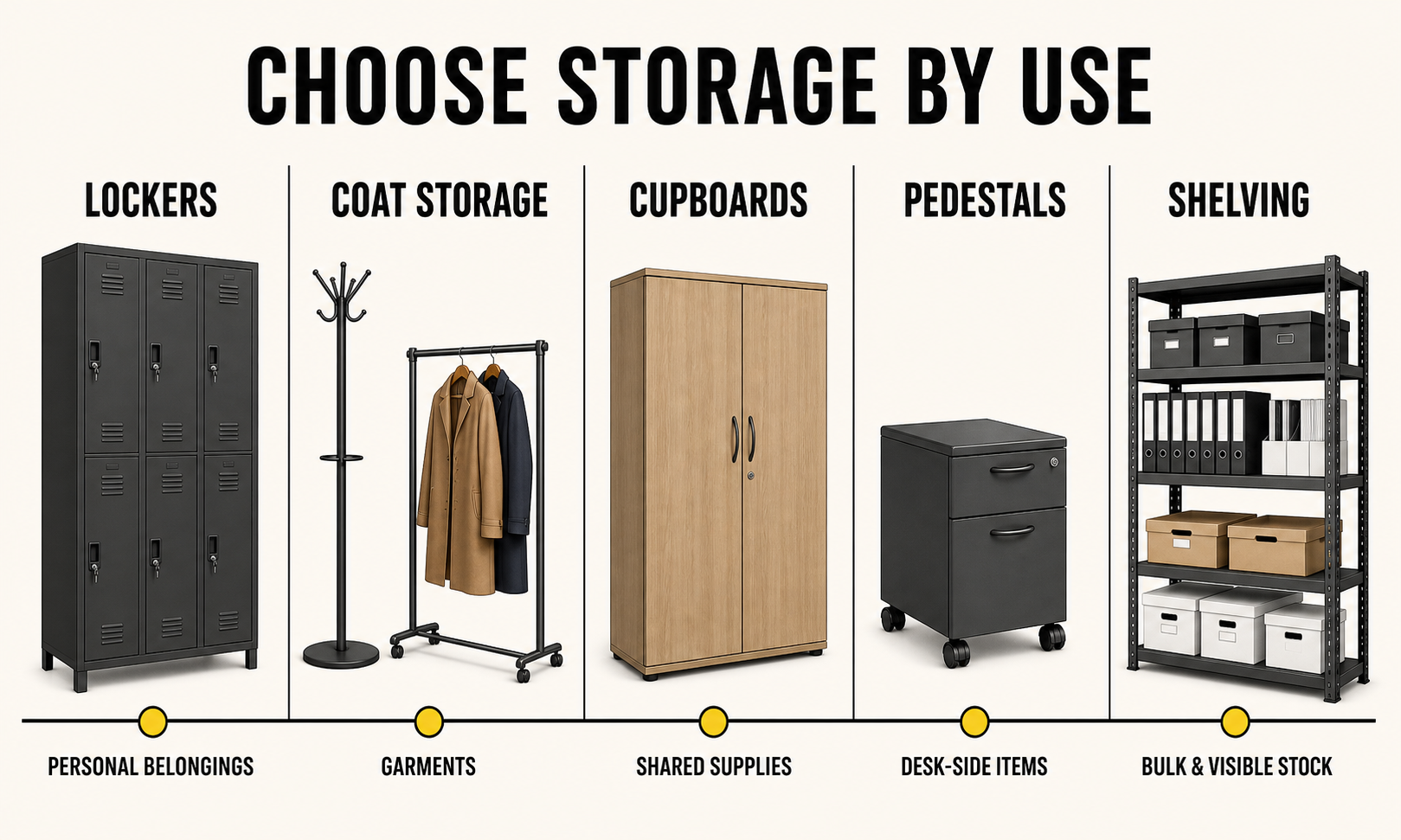
Choose the Storage Type by the Job
The five Storage subcategories solve different workplace problems. Start with the need, then follow the relevant category and checks.
A single workplace can need all five types: personal lockers near an agile workspace, pedestals at assigned desks, cupboards for shared stationery, garment storage near the entrance and shelving in a controlled stock area.
Avoid using one product everywhere simply because it matches. Repetition looks tidy, but the wrong internal format wastes capacity and frustrates users.
Measure Usable Capacity, Not the Outer Box
External width, depth and height tell you whether a unit fits the room. Internal clear dimensions tell you whether the contents fit the unit.
Convert the inventory into dimensions
Measure the widest, deepest and tallest item in each group. For binders and archive boxes, record the direction in which labels must face. For bags or helmets, allow for irregular shapes. For drawers, subtract runners, side walls and handles from the external size.
Adjustable shelves add flexibility, but only if the shelf pitch and the number of supplied shelves work for the intended contents. A tall cupboard with two shelves may hold less organised material than a lower cupboard with several useful levels.
- Ask for internal shelf, drawer or compartment dimensions where the listing does not show them.
- Check clear door opening, not only the carcass width.
- Keep dense items lower and frequently used items within a comfortable reach zone.
- Reserve a modest, intentional growth allowance rather than buying an empty cabinet “just in case”.
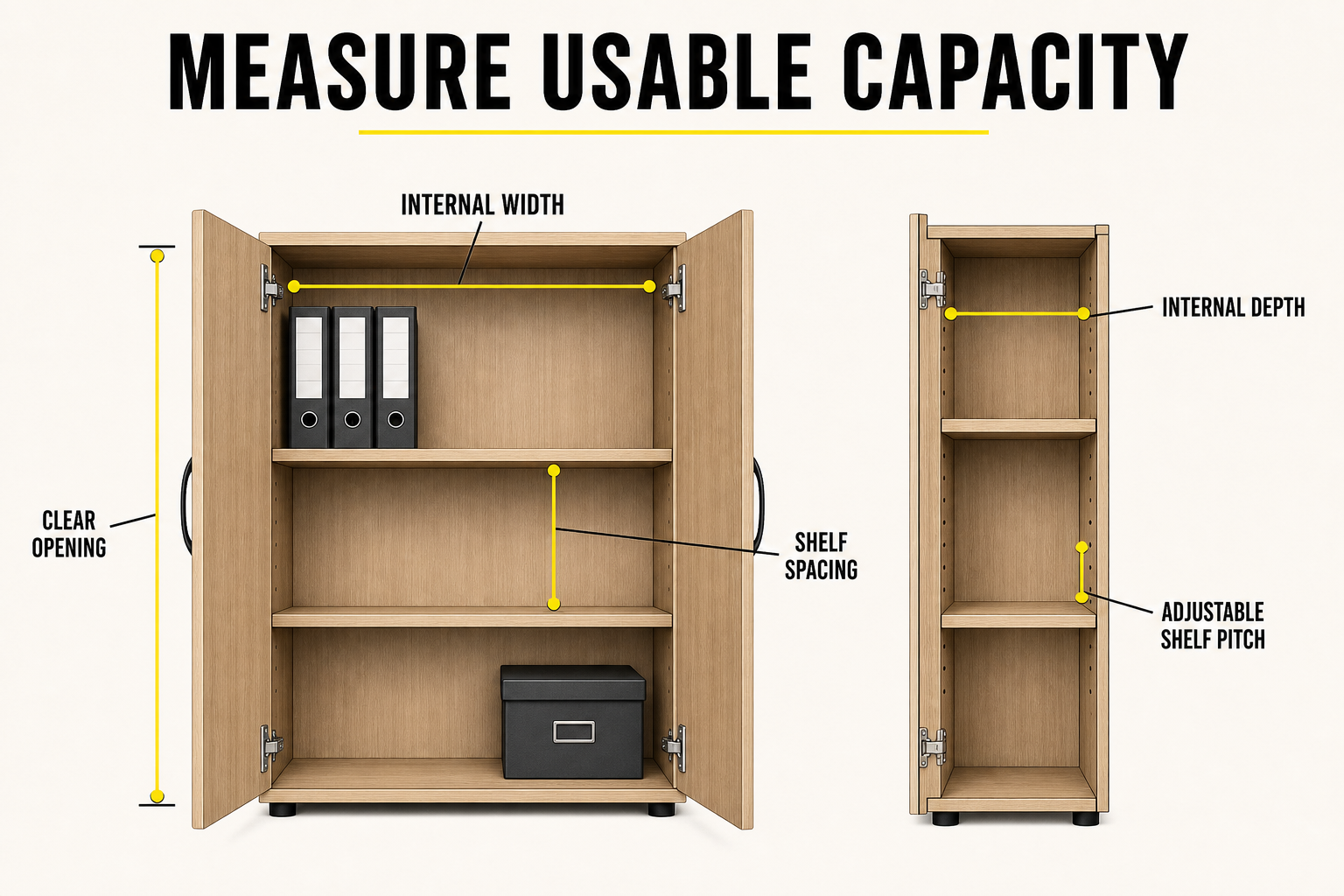
WidthClear openingAllow for hinges, runners, door overlap and internal dividers.
DepthUsable shelf or drawerCheck handles, back panels and filing rail direction.
HeightBetween levelsMeasure to the underside of the shelf above, not the cabinet top.
AccessRetrieval spaceThe item must enter, turn and come out without emptying the unit.
How to Choose Used Office Lockers
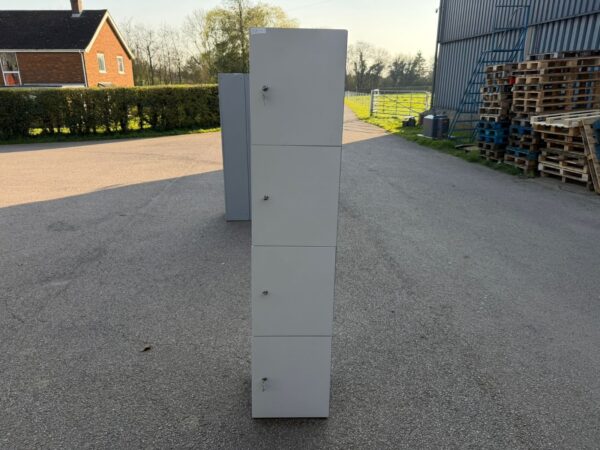
Locker planning begins with the largest personal item, the number of users and who controls the keys or codes.
Compartment count is not capacity
A six-door locker is useful only if each compartment holds what people bring. Measure typical backpacks, laptop bags, helmets, shoes or folded uniforms. Full-height compartments can take coats; smaller doors may work for bags and personal effects.
For hybrid or agile teams, decide whether lockers are permanently assigned, booked or cleared daily. That choice affects numbering, labelling, lock management and how many users each bank can support.
Inspect every lock and door
- Count working keys and confirm master-key or code-reset arrangements.
- Test latches, hinges, door alignment and any ventilation openings.
- Check internal shelves, hooks and dividers are present and firmly fitted.
- Inspect the base, plinth, feet and any fixing points for corrosion or damage.
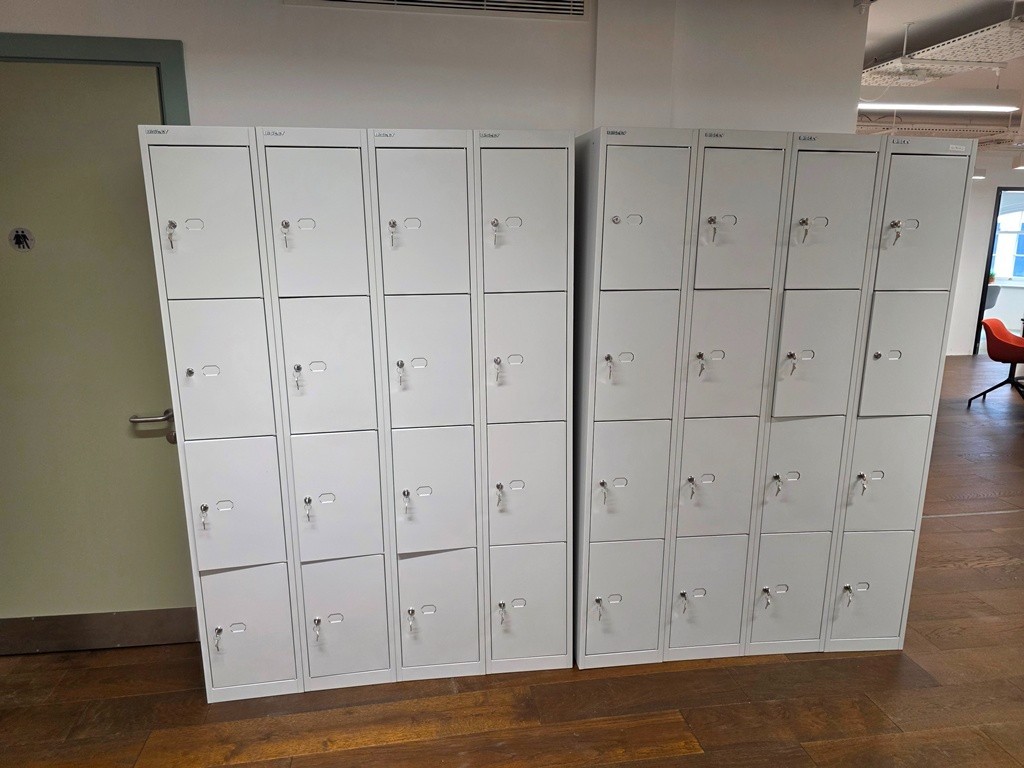
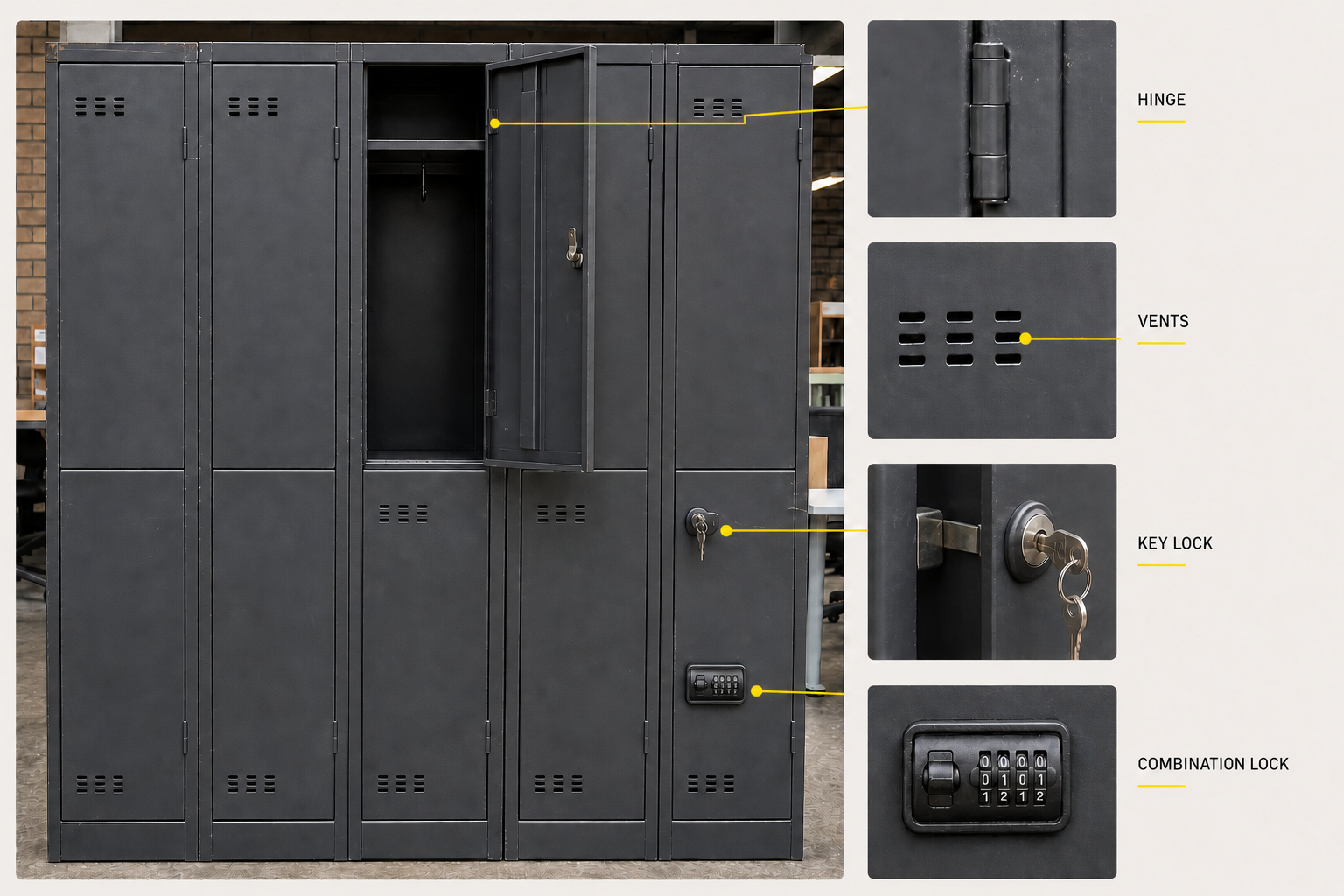
Current stock · Office lockers
Compare live locker sizes and lock formats
Use the listing to verify overall and compartment dimensions, door count, lock type, keys, internal fittings, condition and whether the unit is supplied assembled or dismantled.
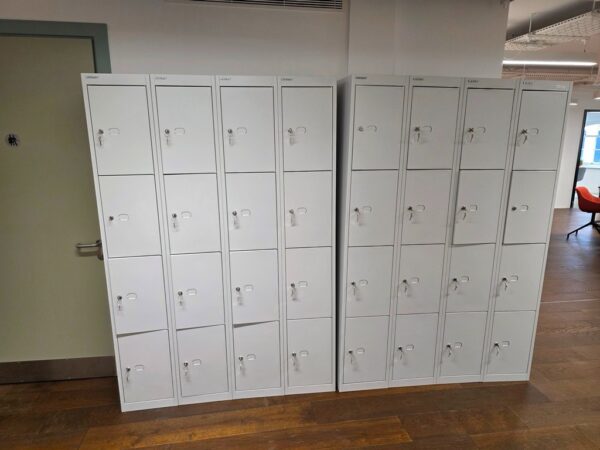
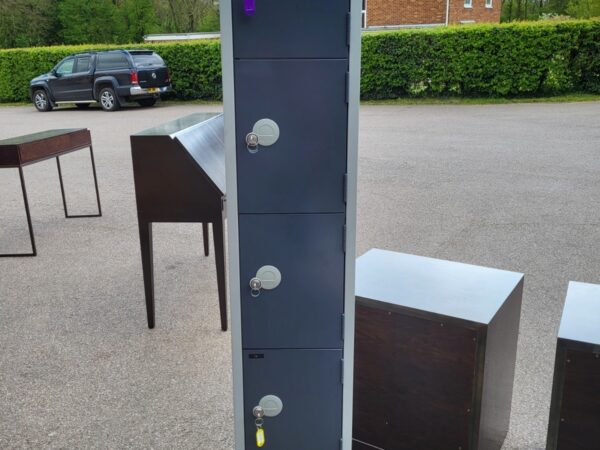
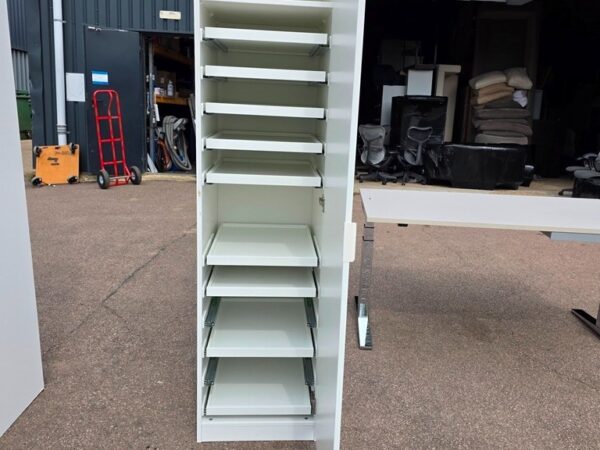
Coat Stands and Garment Rails
Outerwear needs a deliberate home. Without one, chair backs, partitions and door handles become accidental storage.
Choose by volume and floor behaviour
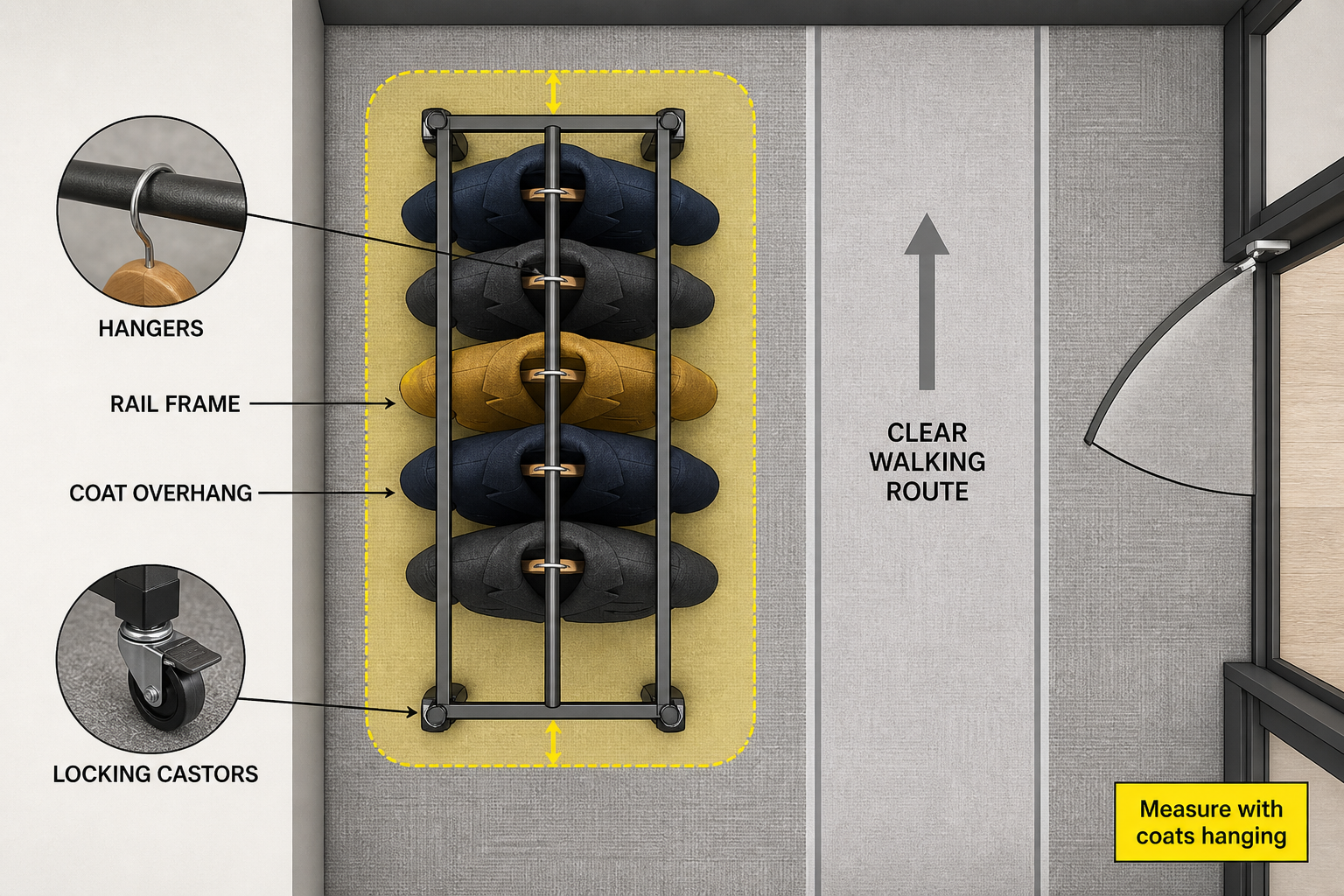
A coat stand can work for a small team or reception because it uses a compact footprint and provides quick access. A garment rail distributes more coats in a line and can make capacity easier to see, but the rail, hangers and hanging garments need more width.
Plan for winter bulk and wet weather, not an empty summer photograph. Place garment storage near the route people naturally use while keeping it away from heaters, door swings and narrow circulation. If umbrellas are expected, provide a drip-safe solution that will not create a slip hazard.
- StabilityCheck the base, joints, hooks, castors and any brakes before loading one side.
- Hook or rail heightConfirm it suits users and the longest garment without dragging.
- CapacityAllow hanger spacing and bulky coats; a rail length is not the same as usable winter capacity.
- PositionKeep garments clear of doors, working chairs, escape routes and heat sources.
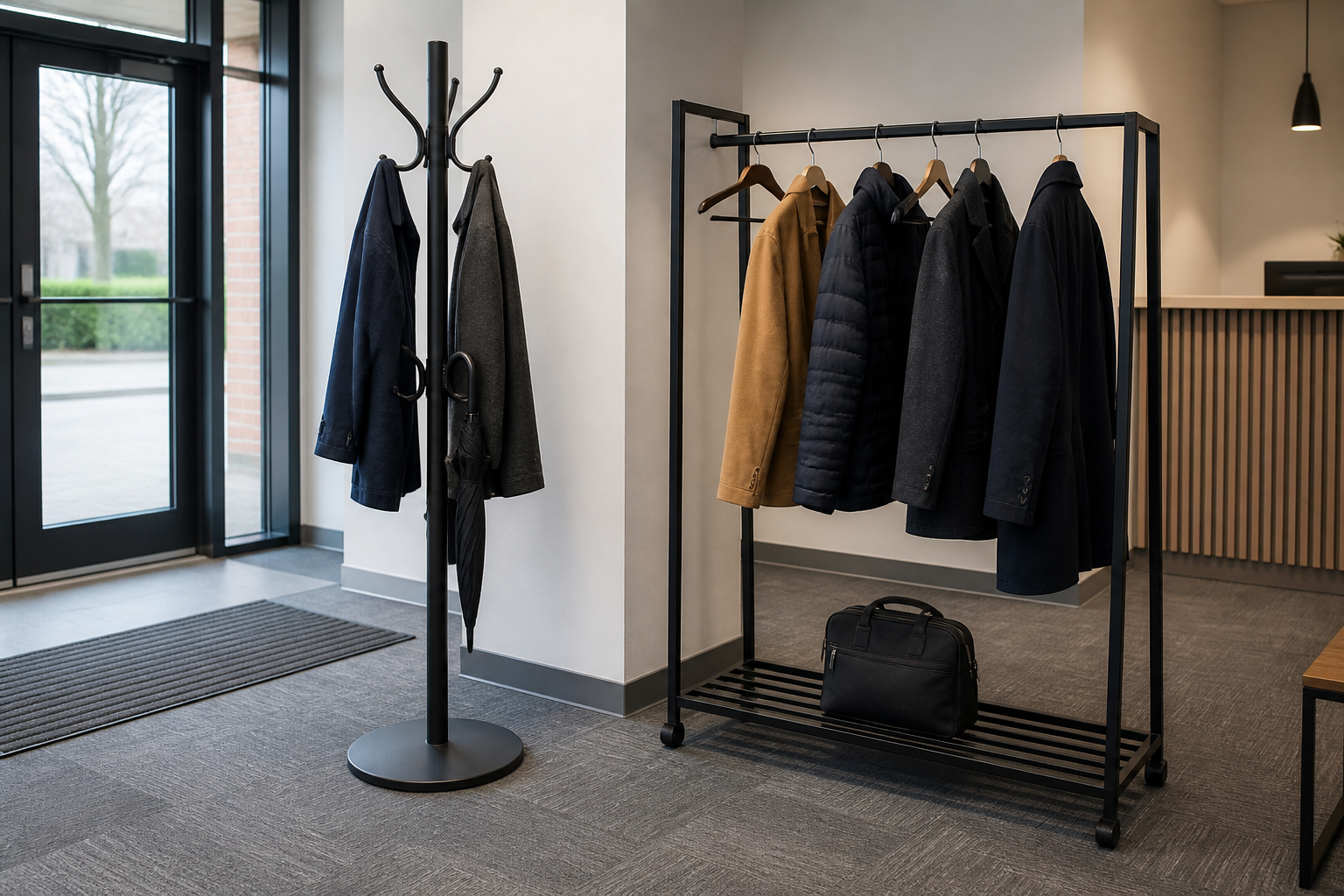
Current stock · Coat stands and garment rails
Plan the coats before comparing the frame
Check total width and height, base design, hooks or hanging rail, castors, brakes and listed condition. Used availability changes, so contact the team if the current range does not match the required quantity.
How to Choose Used Office Cupboards
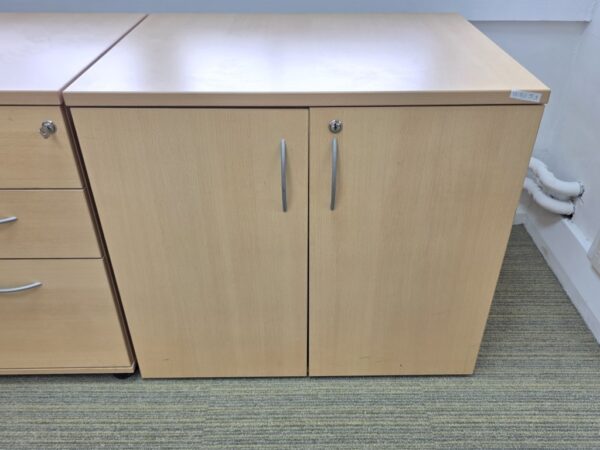
Cupboards are the most versatile shared-storage option, but door type, shelf layout and access space decide how well they use the room.
Pick the door around the floor plan
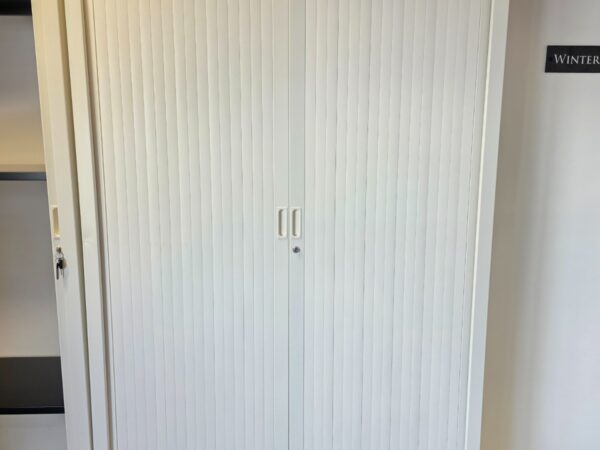
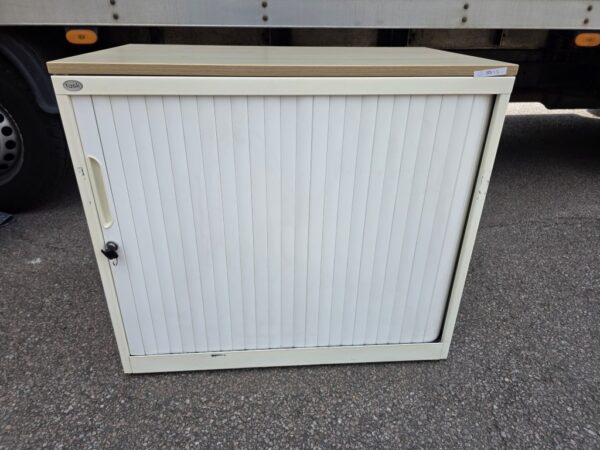
Hinged doors open the full face and make broad contents easy to see, but they need clear swing space. Tambour doors roll into the carcass and sliding doors overlap, so both can work where a passage or workstation sits close in front.
Low cupboards and credenzas can divide zones or provide a secondary surface. Tall cupboards use wall height efficiently but deserve closer attention to stability, fixing guidance and the reach required for upper shelves.
- ShelvesConfirm the number, adjustment range, clips and any declared load information.
- DoorsTest the complete travel, alignment, handles, hinges or tambour action.
- LocksCount keys and confirm whether both doors secure properly when closed.
- InteriorCheck binder depth, shelf pitch and whether dividers or pull-out fittings are included.
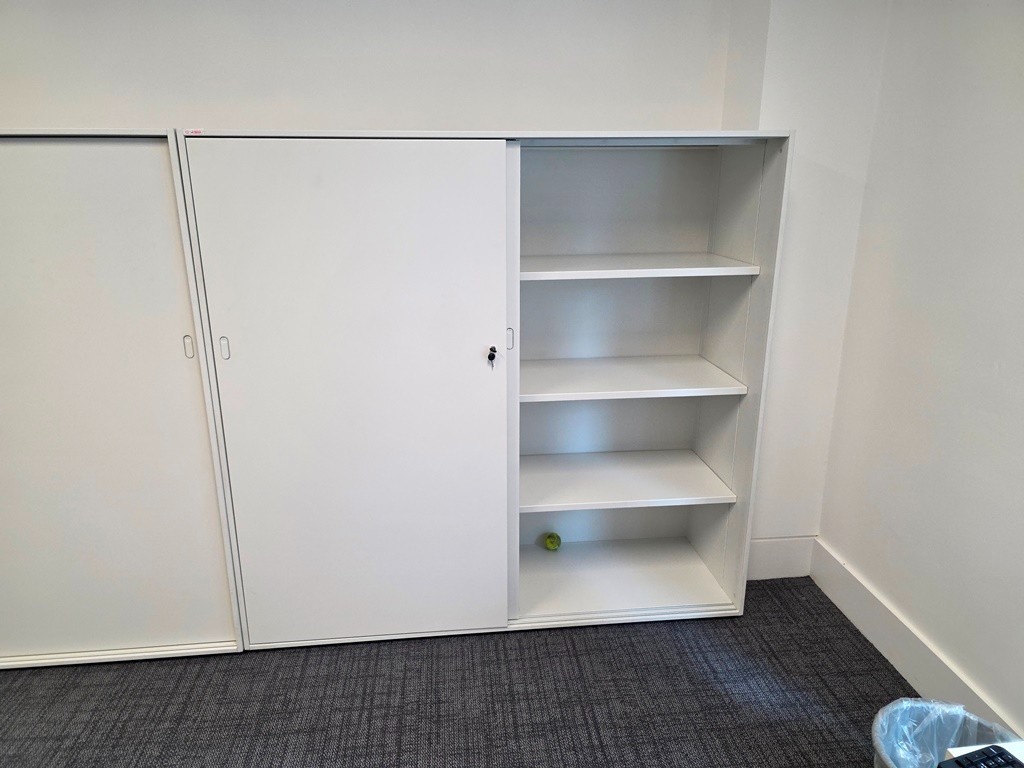
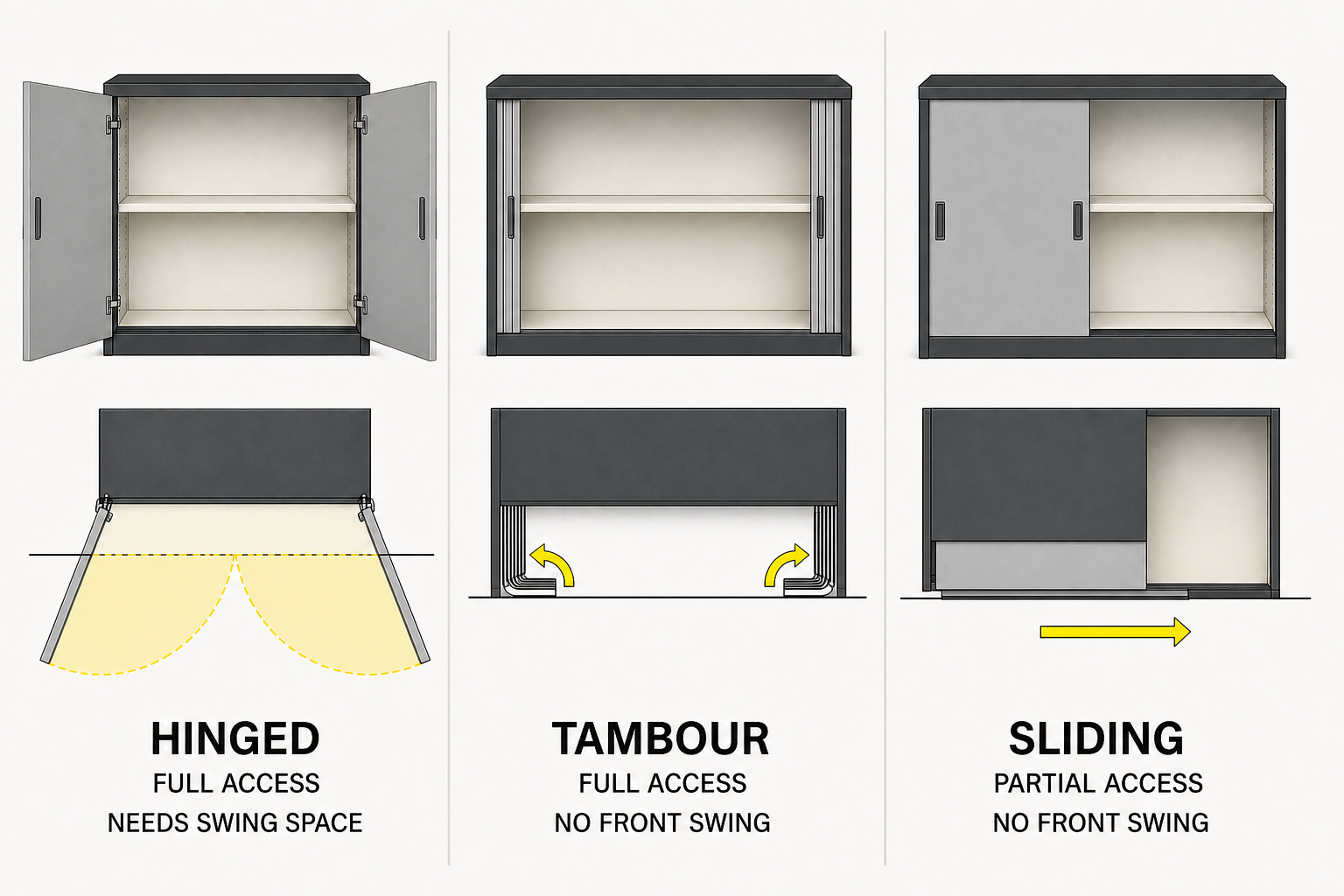
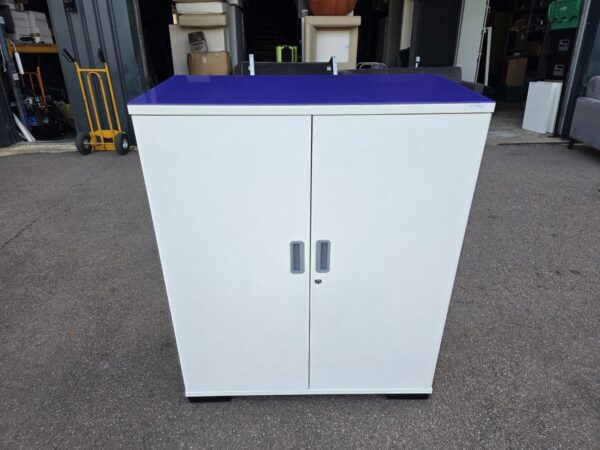
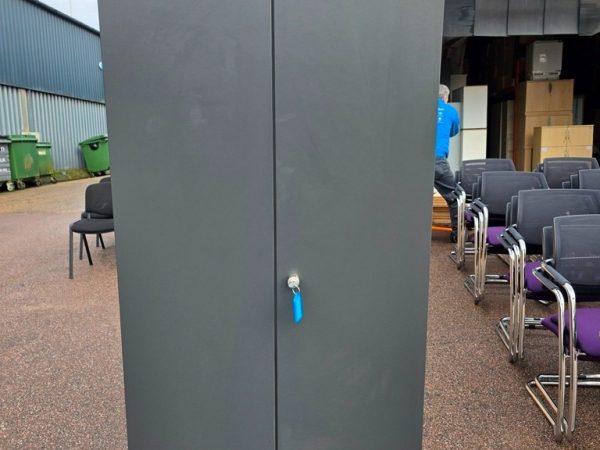
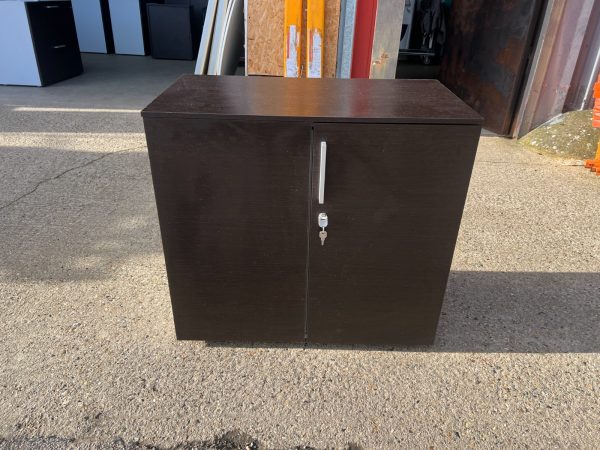
Current stock · Used office cupboards
Compare cupboard height, depth and door operation
Read the exact product description for shelves, keys, internal fittings, dimensions and condition. Match the chosen door type to the available approach and working space.
How to Choose Used Pedestal Cabinets
Pedestals keep active items close to the desk. Their value comes from fit, drawer format and reliable daily movement rather than raw volume.
Mobile, fixed or desk-high?
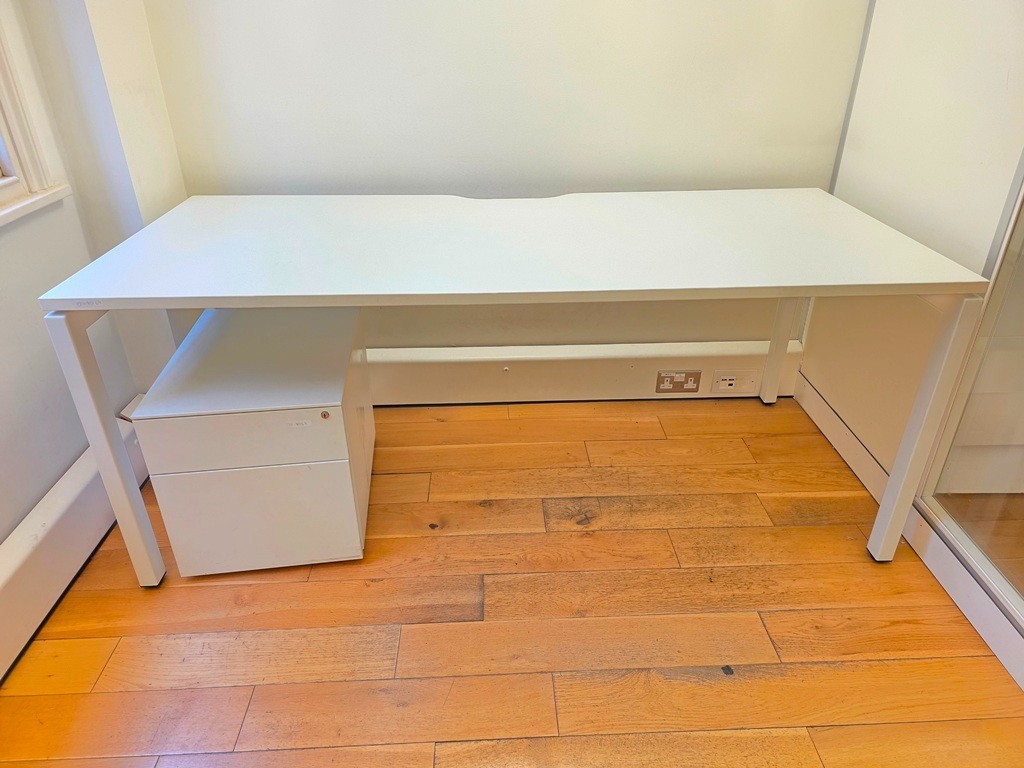
A mobile pedestal usually sits beneath a desk and can move with a workstation change. Confirm its height clears the desk structure and its depth does not remove knee or foot space. A desk-high pedestal can extend the working surface, but the top height and finish must align with the adjacent desk.
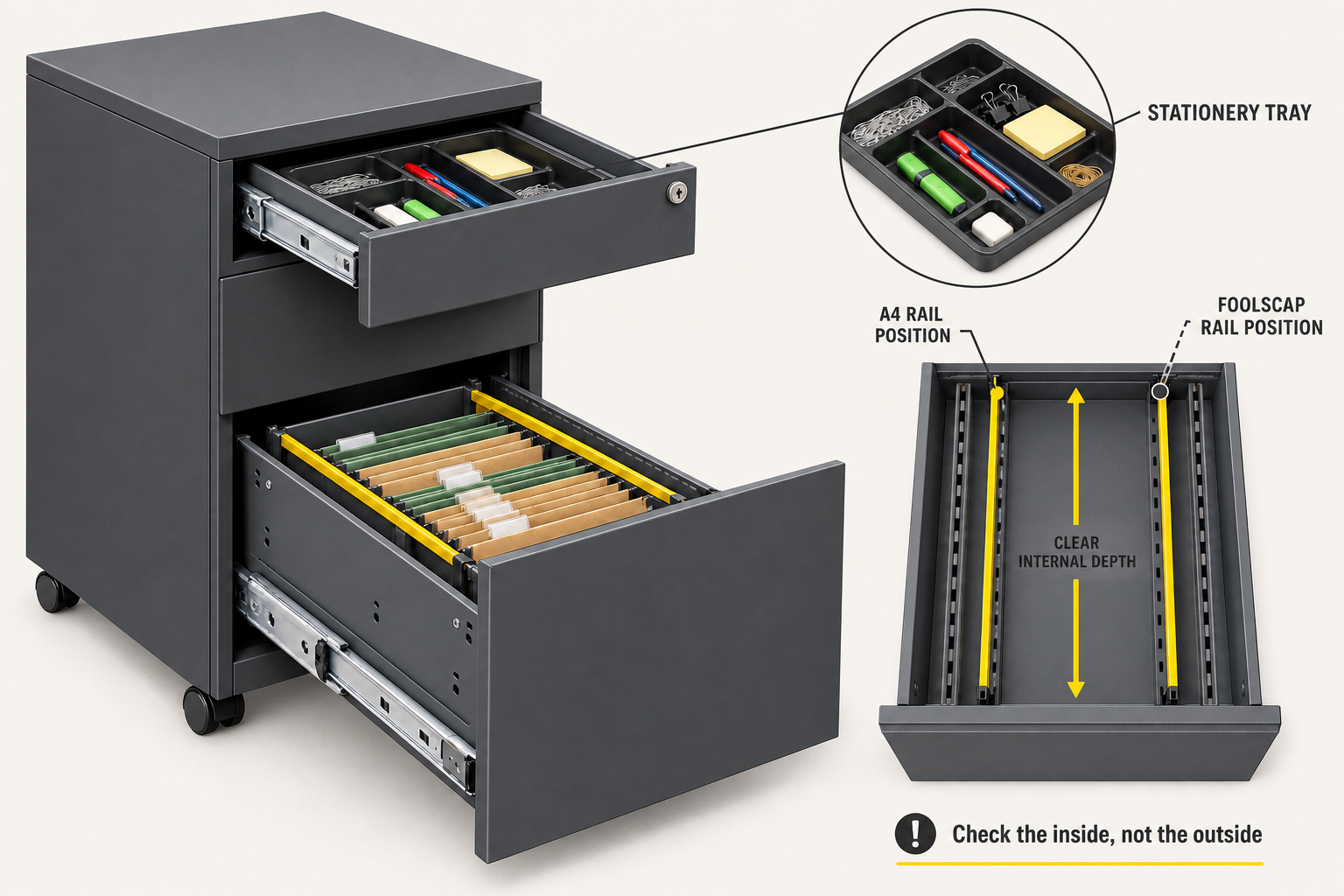
Two-drawer pedestals often combine a shallow personal drawer with a deeper filing drawer. Three-drawer versions provide more stationery separation. The labels are not universal, so inspect the internal layout rather than ordering by drawer count alone.
- Test runners through their full travel and check drawers do not drop or bind.
- Confirm castors are complete, secure and suitable for the floor.
- Check whether the lock controls one drawer or all drawers.
- Look for an anti-tilt or interlock mechanism where fitted and never defeat it.
Current stock · Used pedestal cabinets
Check the pedestal against the desk
Verify overall height and depth, drawer configuration, filing rails, lock and key, castors, handle style and condition. Stock may be limited or one-off, so confirm matching quantities before planning a full floor.
How to Choose Used Shelving and Racking
Open storage makes stock easy to see, but it also exposes loading, housekeeping and structural decisions that a cupboard can hide.
Separate office shelving from heavier racking
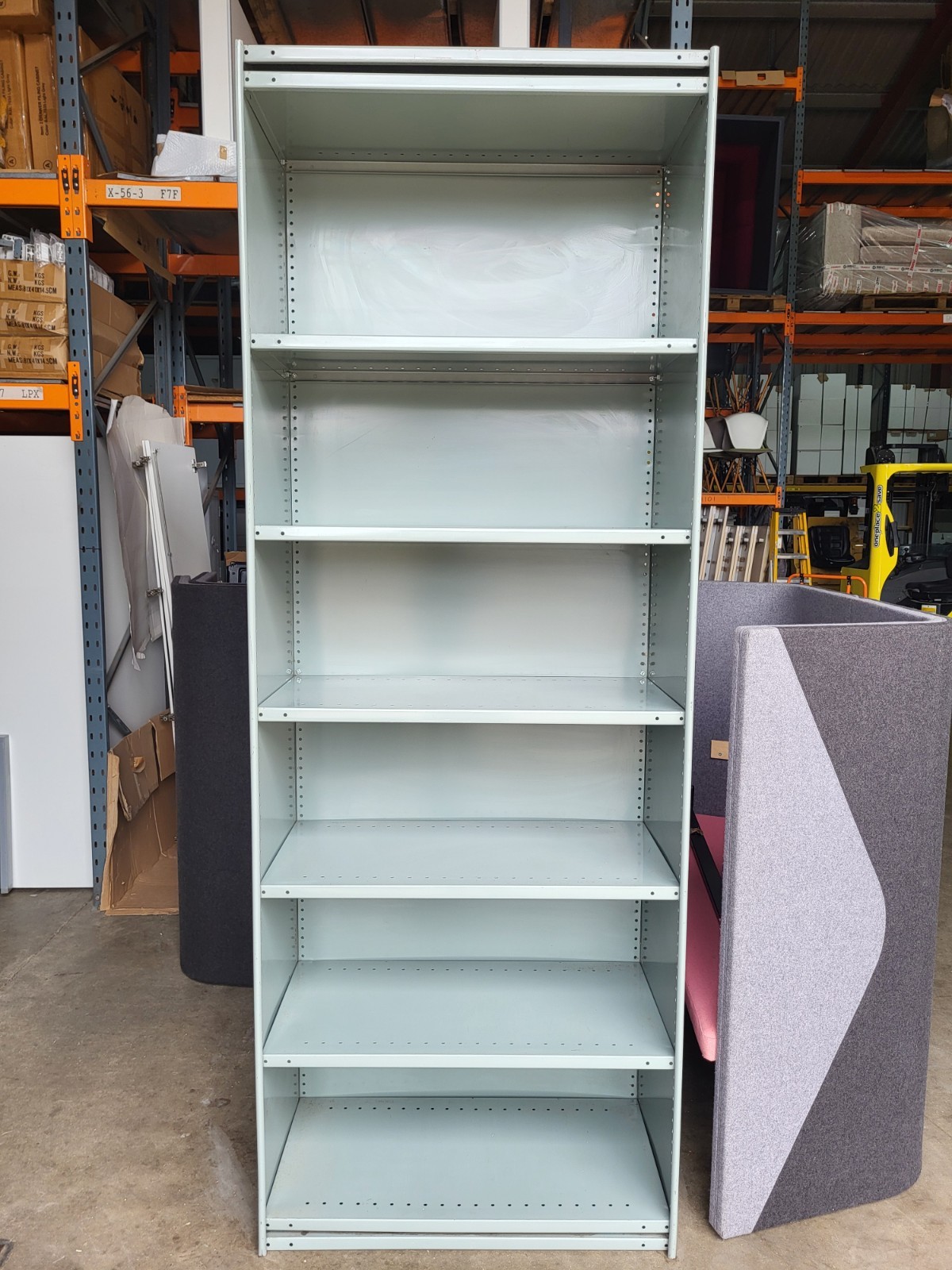
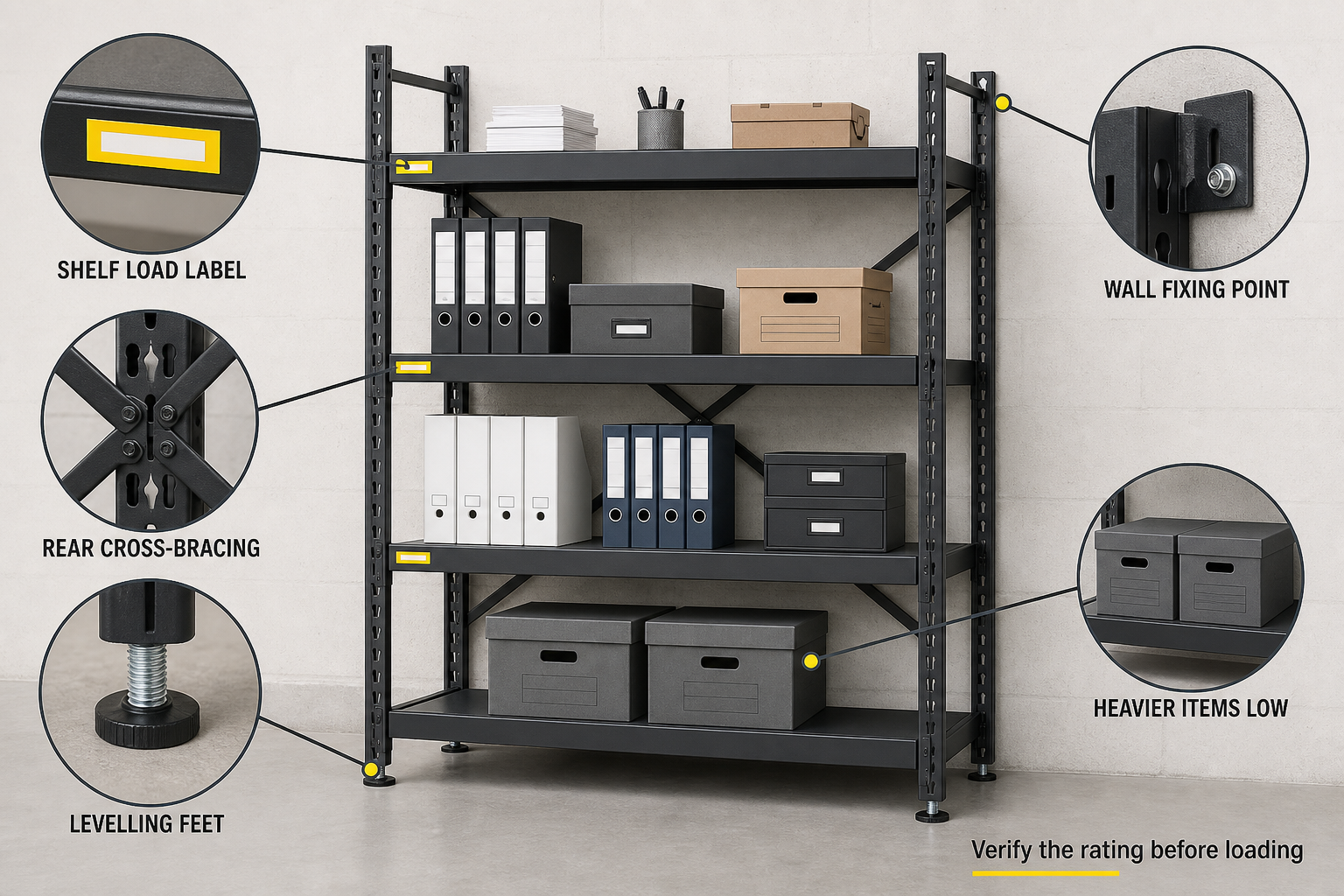
Bookcases and light office shelving suit binders, display items and modest workplace supplies. Larger racking systems may be intended for archive boxes, stockrooms or commercial loads and can require specific beams, braces, deck panels, load notices, fixings and inspection arrangements.
Do not combine frames, beams, clips or shelves because they look similar. Structural compatibility must be confirmed. If product identity or load information is missing, ask the supplier and use a competent racking specialist before installation or use.
Plan retrieval as carefully as capacity
Store dense items at lower levels, keep frequently used stock in a practical reach band and preserve labels. If staff need steps or handling equipment, plan the space and risk controls around that activity rather than squeezing the maximum number of bays into the room.
| Format | Typical role | Check before buying | Common planning mistake |
|---|---|---|---|
| Bookcase / office shelf | Binders, books and lighter shared supplies | Shelf depth, clips, bowing, back and stability | Loading high shelves with dense archive material |
| Adjustable steel shelving | Stock, boxes and facilities supplies | Complete uprights, shelves, braces, fixings and load data | Assuming every shelf position has the same capacity |
| Archive or stockroom racking | Higher-volume boxed records or commercial stock | System identity, beams, decks, braces, damage, design and installation | Mixing incompatible components or omitting inspection |
| Mobile shelving system | High-density storage where designed for the building | Floor, track, mechanism, load, access and specialist installation | Treating it as ordinary freestanding furniture |
Current stock · Used shelving and racking
Match the system to the contents and site
Confirm whether the listing is office shelving or a larger racking system, then verify components, dimensions, condition, declared capacity, dismantling, delivery and installation requirements.
Loads, Stability, Fixing and Inspection
A cabinet or shelf that looks substantial does not advertise its safe load. Product identity, condition and installation matter.
Use evidence, not appearance
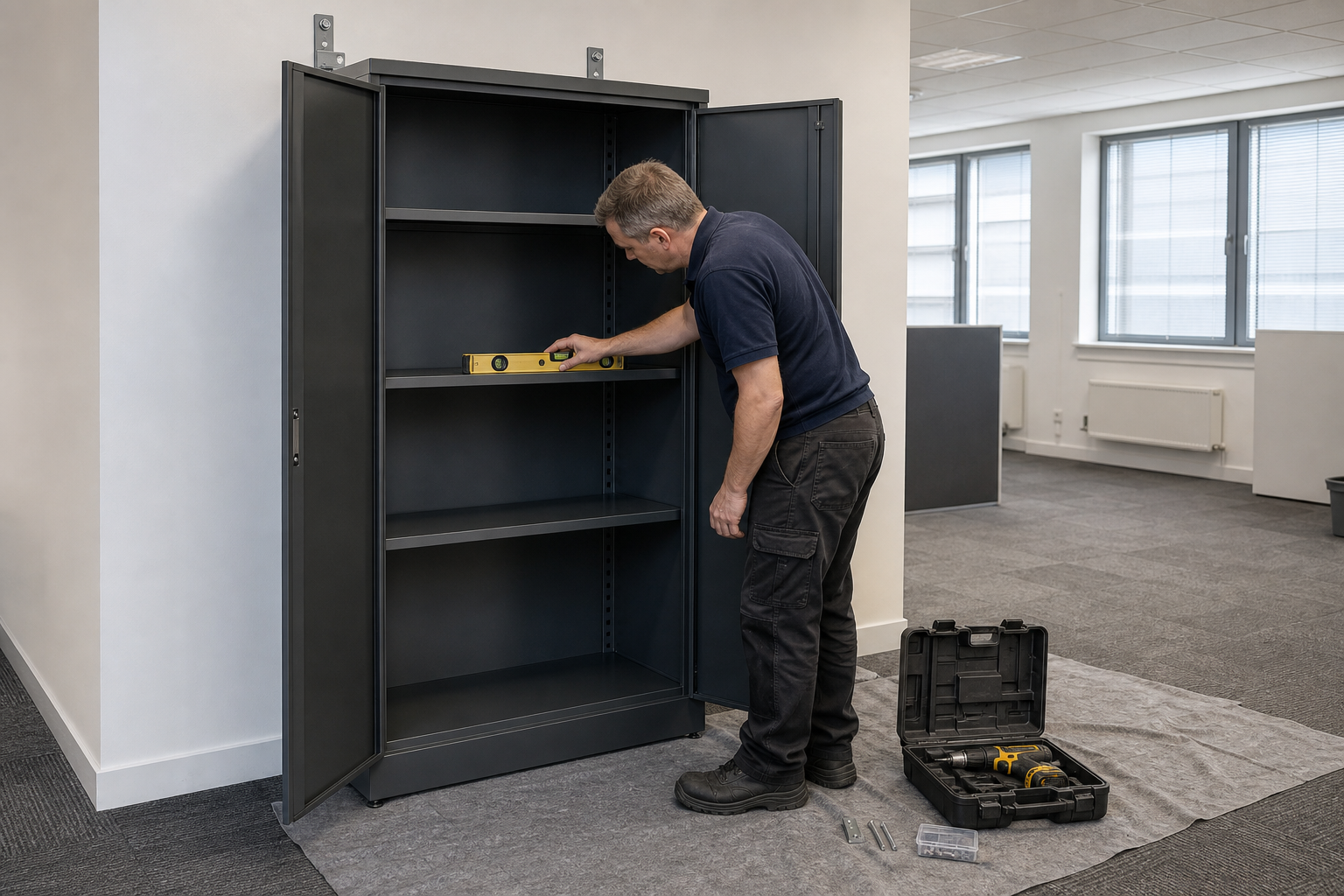
Look for manufacturer labels, assembly information and load notices. Check shelves for bowing, uprights for impact damage, braces for completeness and fixing points for distortion. Position heavier contents lower to reduce overturning tendency, but do not treat that as a substitute for required restraints or correct installation.
For racking, the HSE explains that damage reduces load-carrying capacity and that storage equipment should be inspected regularly. The inspection frequency should reflect the operating conditions. Use the original system guidance and a competent racking specialist where the installation warrants it.
Match Security to the Contents and the People
“Lockable” is a feature, not a complete security plan. Decide what is being protected, from whom and how access will be managed.
Build layers of control
Open shelving may be enough for low-value communal stationery. A shared cupboard can reduce casual access. Personal lockers separate belongings. Confidential paper records can require lockable storage within a more controlled area, plus documented responsibility for keys, codes and record handling.
The ICO’s physical-security guidance recommends risk-assessing secure areas, storing physical records in lockable rooms and filing cabinets, and documenting who can access them. A lock therefore supports good governance; it does not replace retention rules, access records, clear-desk practice or secure disposal.
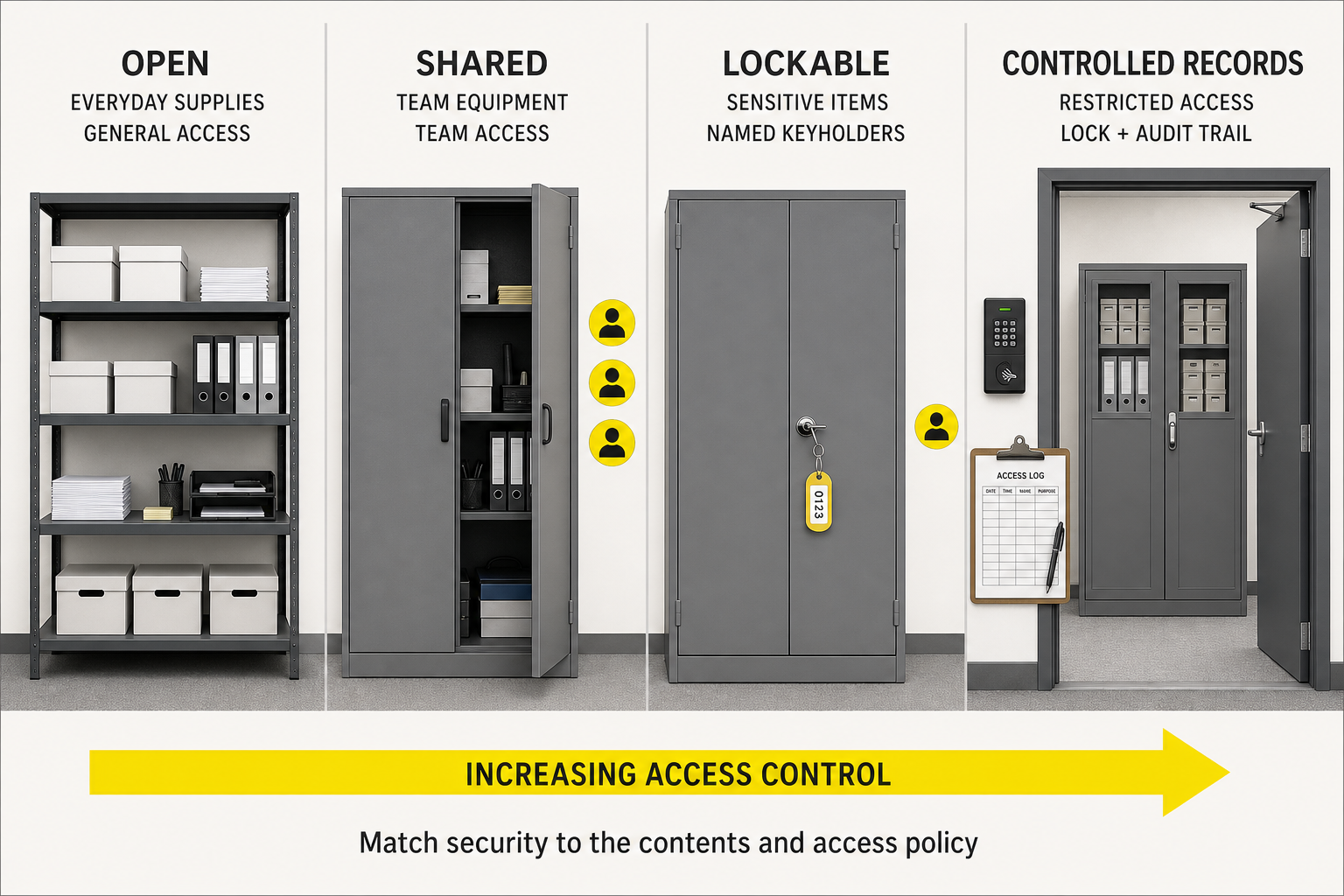
Level 1OpenLow-risk communal items where visibility and speed matter most.
Level 2SharedA team cupboard or room with clear ownership and housekeeping.
Level 3LockableNamed key or code holders with a process for changes and leavers.
Level 4ControlledRestricted area, documented access and records-management controls matched to risk.
Plan Files, Binders and Archive Boxes Properly
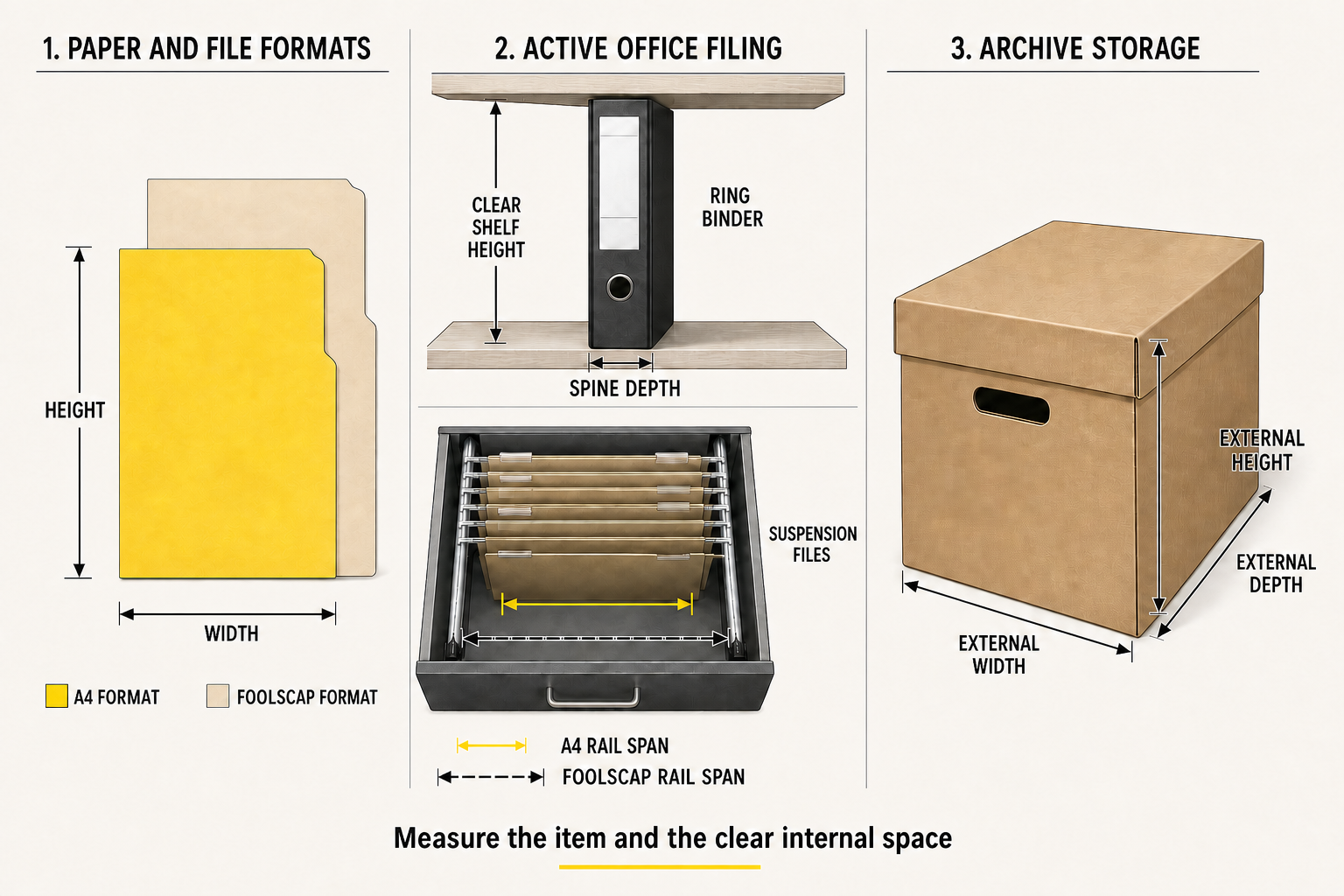
Paper storage fails when formats are treated as interchangeable. A4 sheets, foolscap suspension files, lever-arch binders and archive boxes occupy space differently.
Confirm the working format
Measure the actual binder or box including finger pulls, tabs and lids. For suspension filing, verify rail spacing, orientation and clear drawer depth. A deep pedestal drawer without the correct rails is simply a deep drawer.
If records are active, keep labels visible and allow folders to be removed without crushing adjacent files. If they are archived, confirm retention and secure-disposal policies before buying more furniture to hold material that should no longer be kept.
Dedicated used filing cabinets are worth comparing when paper filing is the main purpose. Cupboards and shelves are better for mixed binders, boxes and equipment when their internal dimensions suit.
Place Storage Around Work, Access and Escape
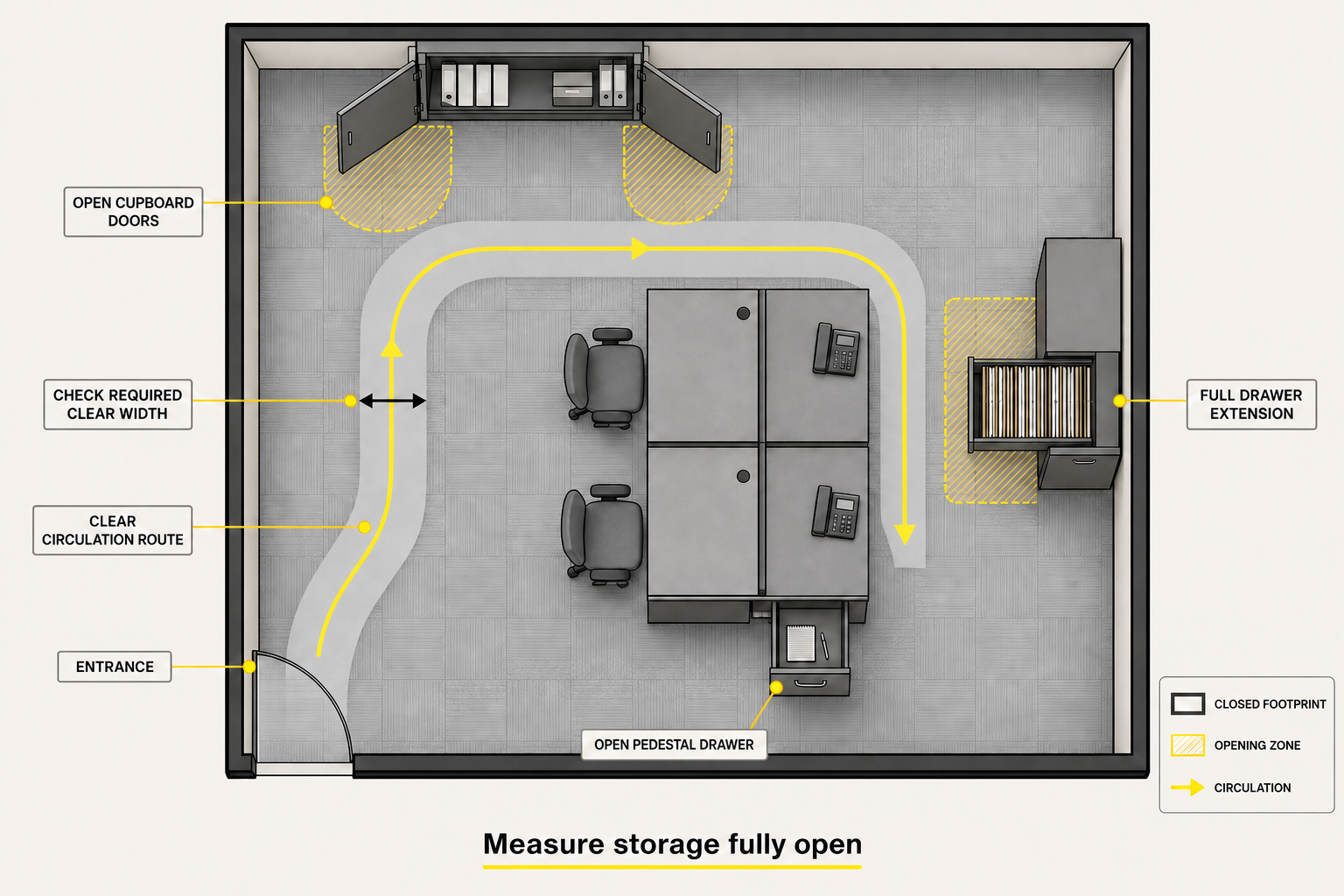
The closed cabinet footprint is only the start. People need to approach it, open it, retrieve contents and pass safely.
Draw the open state
Add hinged doors, extended drawers, people, step stools, trolleys and the largest item being removed to the floor plan. Keep storage away from door swings, radiators, controls, glazing, electrical equipment and areas where it would narrow a required route.
GOV.UK workplace fire-safety guidance requires clear passageways to escape routes. Storage must not turn corridors, stairs or the area in front of fire equipment into overflow space. Check the site’s fire-risk assessment and competent advice for the actual building.
Accessible placement also depends on the users. Keep frequently needed items within practical reach, provide a clear approach and avoid requiring one person to stretch, kneel or move obstacles. Current Approved Document M provides a baseline for access in buildings in England; project and regional requirements may differ.
Materials, Finishes and Visual Coordination
Finish affects durability, cleaning, weight and how easily separate used items can be made to feel intentional.
Judge the construction as well as the colour
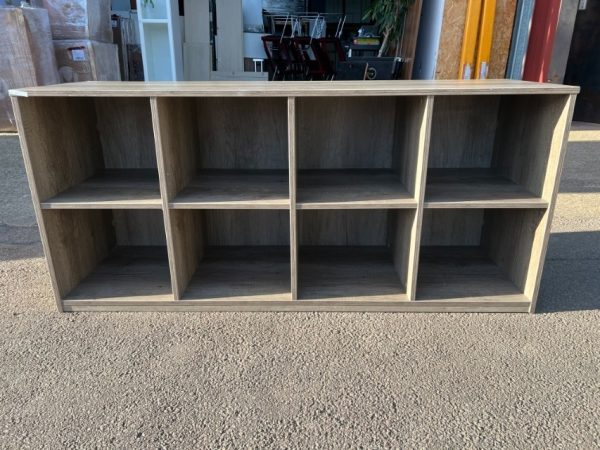
Steel storage can suit high-use areas and is often visually slim, but check dents, corrosion, powder-coat wear and door alignment. MFC or laminate cupboards coordinate easily with desks; inspect edge banding, fixings and moisture damage. Veneer adds natural variation and may show repairable surface wear, while glass doors require careful chip and support checks.
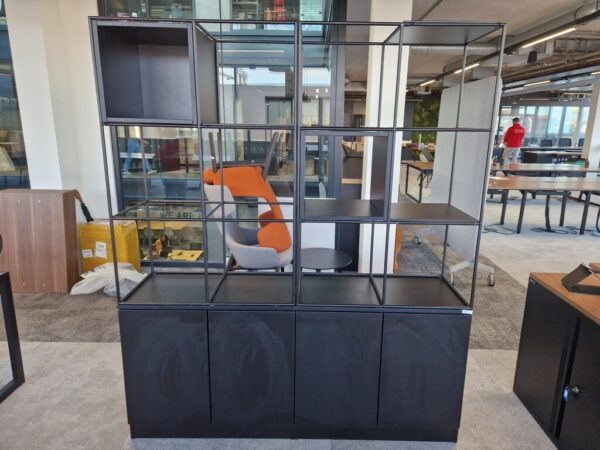
For a mixed used scheme, coordinate by broad colour family, height line and handle rhythm. Black, grey or white metal storage can bridge different desk finishes. A repeated accent colour or labelling system can make non-identical lockers and cupboards look purposeful without pretending they are one range.
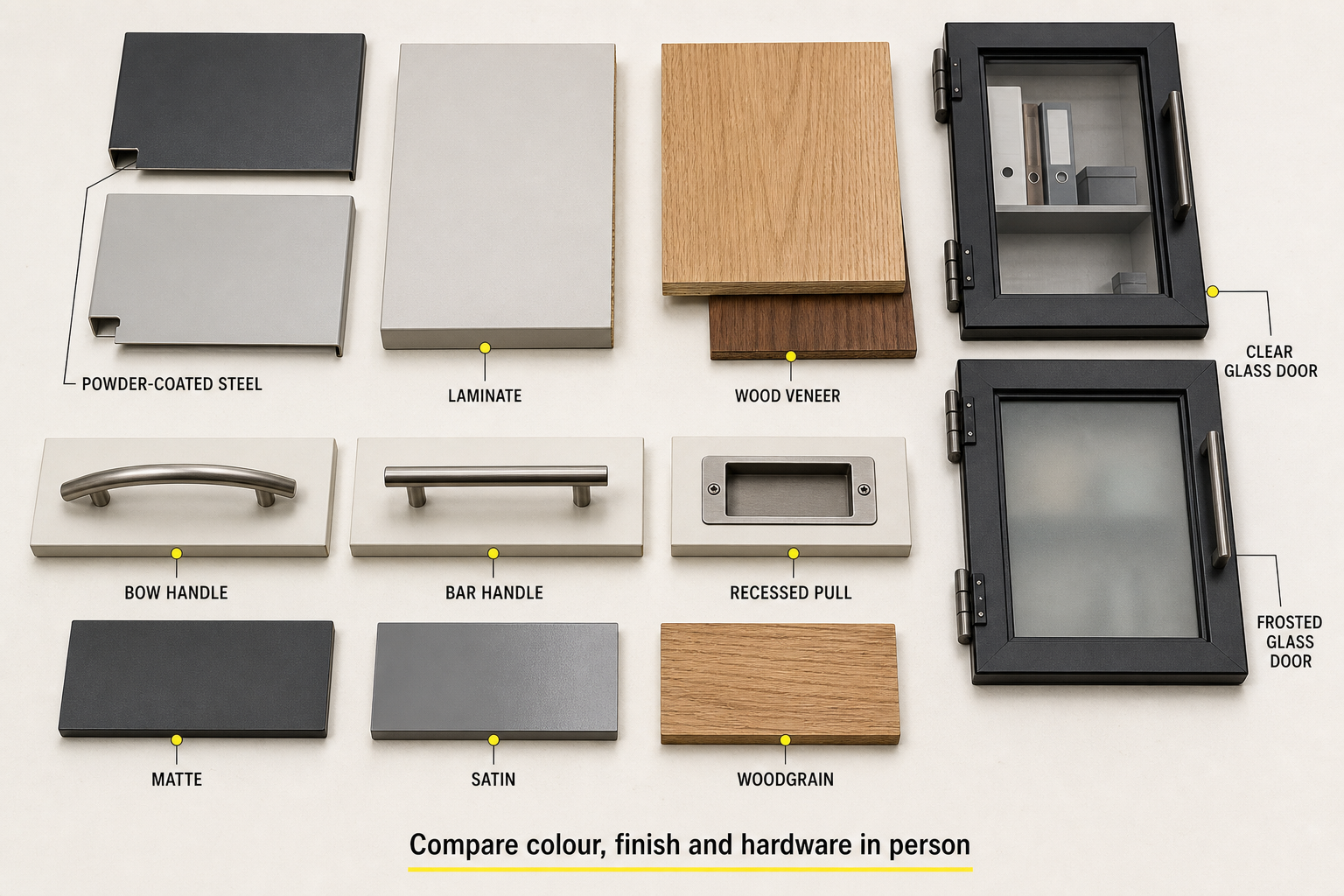
| Material | Useful qualities | Used-condition focus | Best coordination move |
|---|---|---|---|
| Powder-coated steel | Commercial, compact-looking and suited to lockers or shelving | Dents, rust, scraped coating, bent doors and damaged fixings | Repeat one neutral metal colour across mixed zones |
| MFC / laminate | Easy to match with desks and available in many finishes | Edge lifting, chips, swelling, loose hinges and worn locks | Align top height and use a related wood or neutral family |
| Veneer | Natural grain and a more furniture-led appearance | Water marks, lifting veneer, faded areas and repair history | Let grain vary; keep surrounding metal and handles consistent |
| Glass-fronted storage | Contents remain visible while protected from casual handling | Chips, scratches, supports, hinges and safe delivery | Use selectively for display rather than every storage need |
What to Check Before Buying Used Office Storage
Cosmetic wear may be acceptable. Missing structural, locking or moving components can change whether the unit is usable at all.
Inspect from outside to inside
First check whether the carcass is square, stable and complete. Then test each door, drawer, lock, shelf and moving part. Photograph labels, keys, fixings and any damage. If several matching units are required, ask whether condition and components are consistent across the quantity rather than shown by one example.
Used furniture can show marks from normal commercial service. Decide what is acceptable for the intended room, but do not let a good front panel distract from a missing back, bent runner or incompatible shelf.
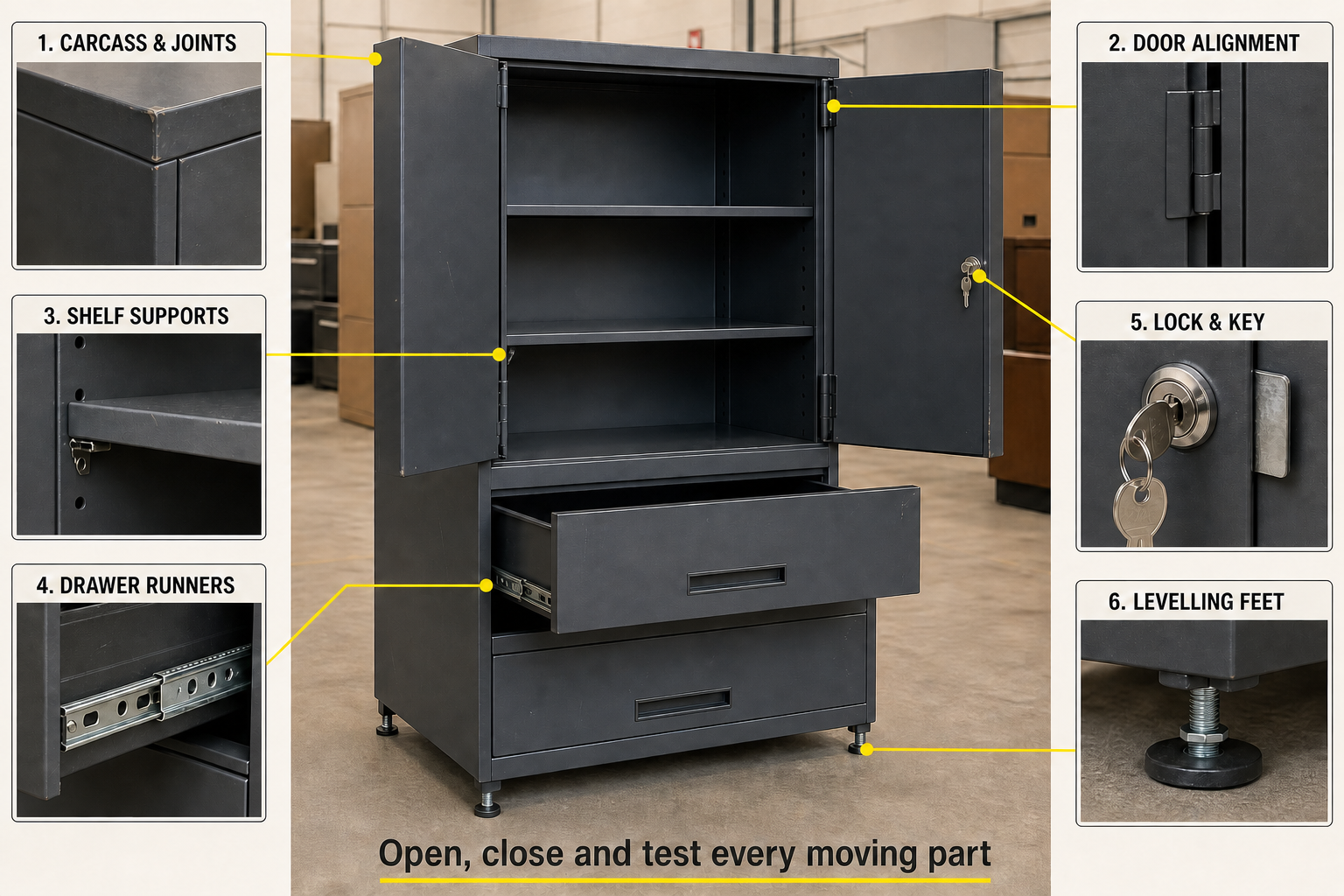
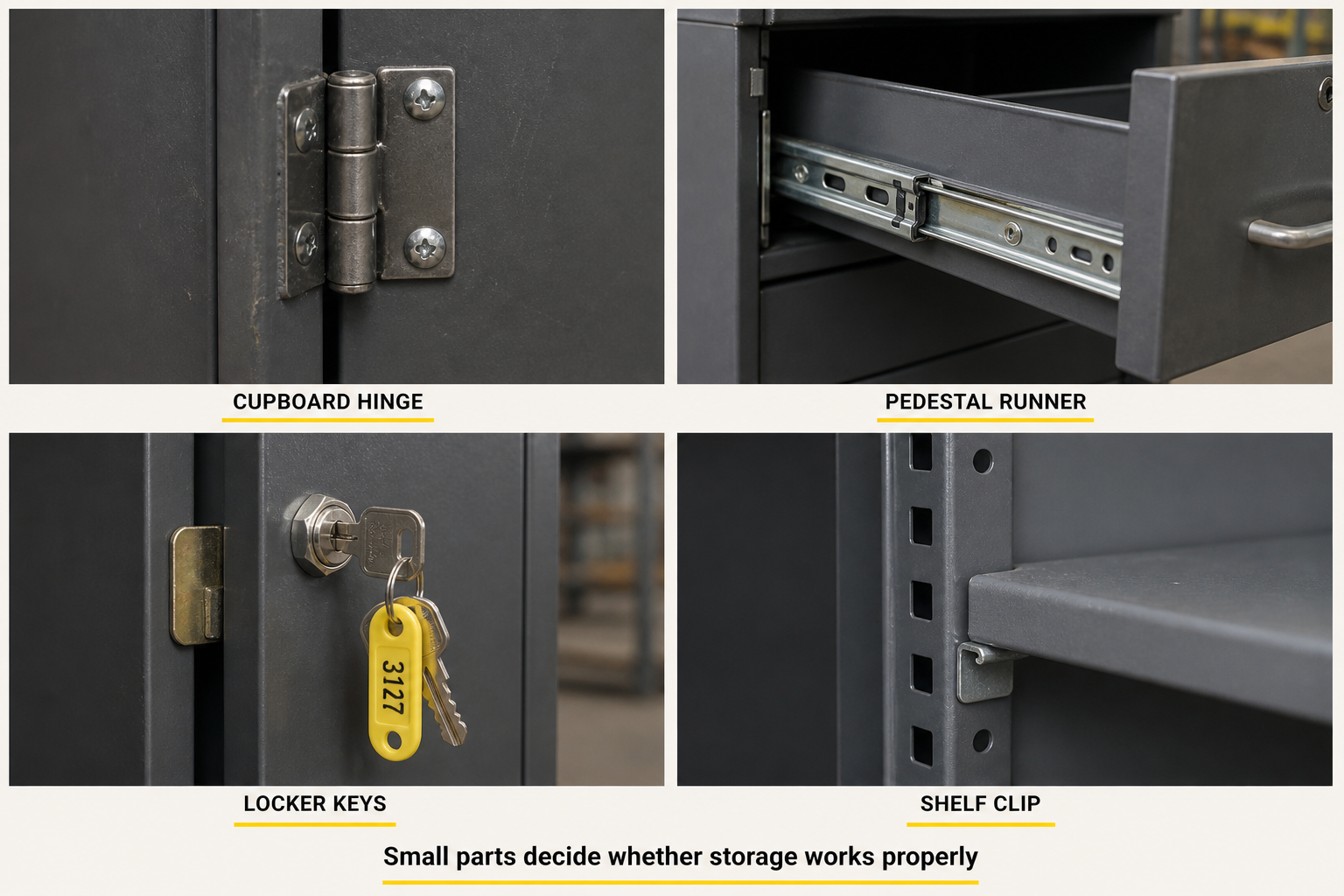
01Carcass and backSquare, stable, complete, free from serious impact, swelling or corrosion.
02Shelves and clipsCorrect quantity, compatible fittings, no serious bowing and useful adjustment.
03Doors and hingesAligned, supported, complete travel and secure closure without rubbing.
04Drawers and runnersSmooth full travel, stops present and no dropping, binding or twisting.
05Locks and accessEvery lock tested; working keys, codes or reset process clearly counted.
06Base and fixingsFeet, castors, brakes, plinth, levellers, braces and supplied fixings complete.
Measure Delivery, Assembly and Final Installation
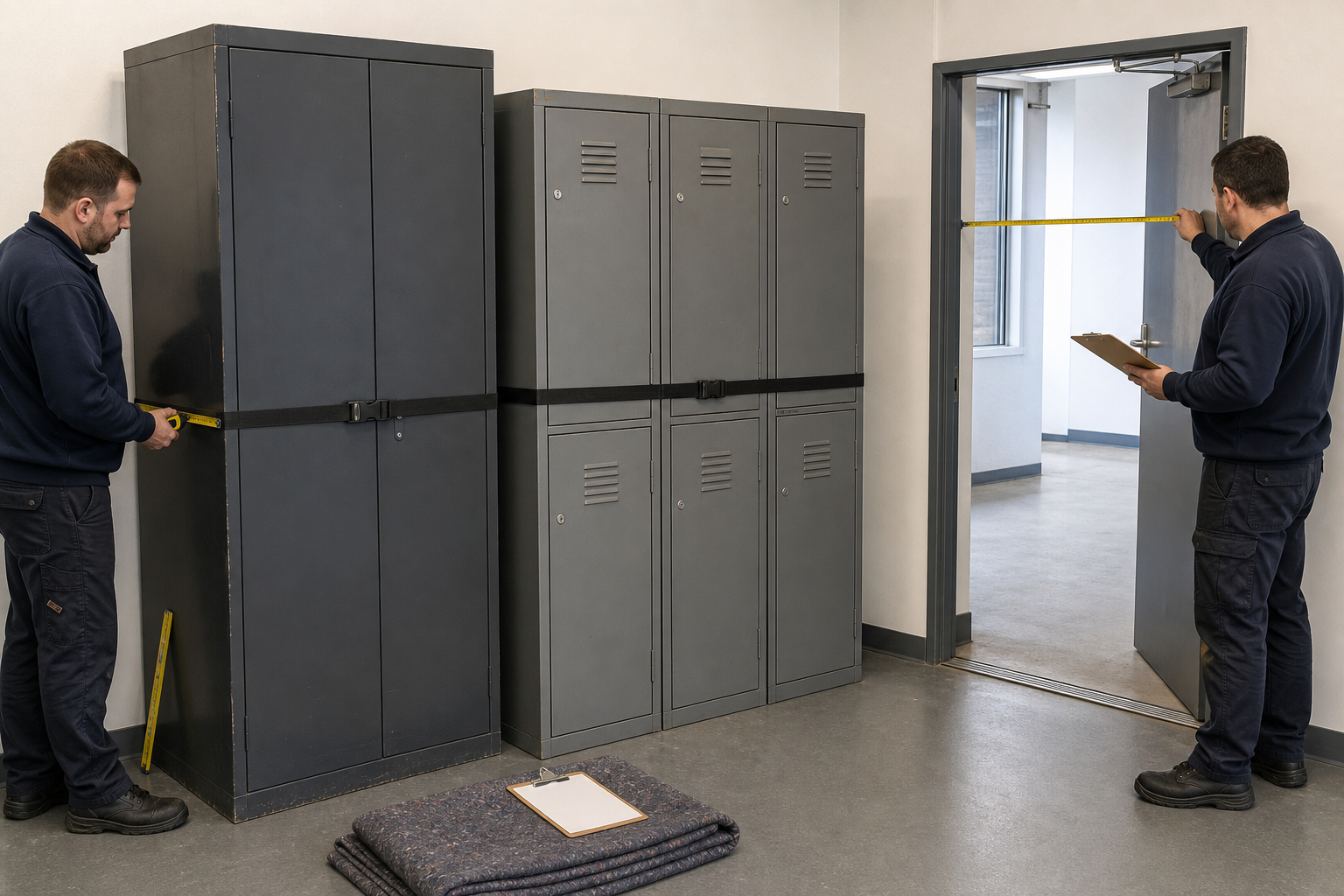
Tall cupboards, locker banks and racking can fit the destination wall but fail at the vehicle access, lift, turn or doorway.
Ask how the product travels
Confirm whether the unit arrives assembled, partly dismantled or flat. Ask for the largest component dimensions and approximate weight. Handles, feet and packaging can add to the nominal size. Measure every fixed point from unloading to final position and reserve enough room to stand, connect, level and secure the item.
The HSE’s manual-handling guidance tells employers to avoid hazardous handling where reasonably practicable, assess unavoidable tasks and reduce risk. Plan people, lifting aids, parking, stairs and awkward turns before delivery rather than improvising around a heavy cabinet.
Product
Largest component, weight, packaging, handles, doors and dismantling sequence.
Route
Parking, entrance, thresholds, corridor width, corners, stairs and lift.
Room
Final door, ceiling, floor, services, assembly zone and neighbouring furniture.
Install
People, aids, levelling, fixing instructions, waste removal and handover checks.
Coordinate Used Storage for a Longer Working Life
Reuse is strongest when the storage solves the right problem, can be maintained and remains useful after the next team change.
Build a system without requiring one product family
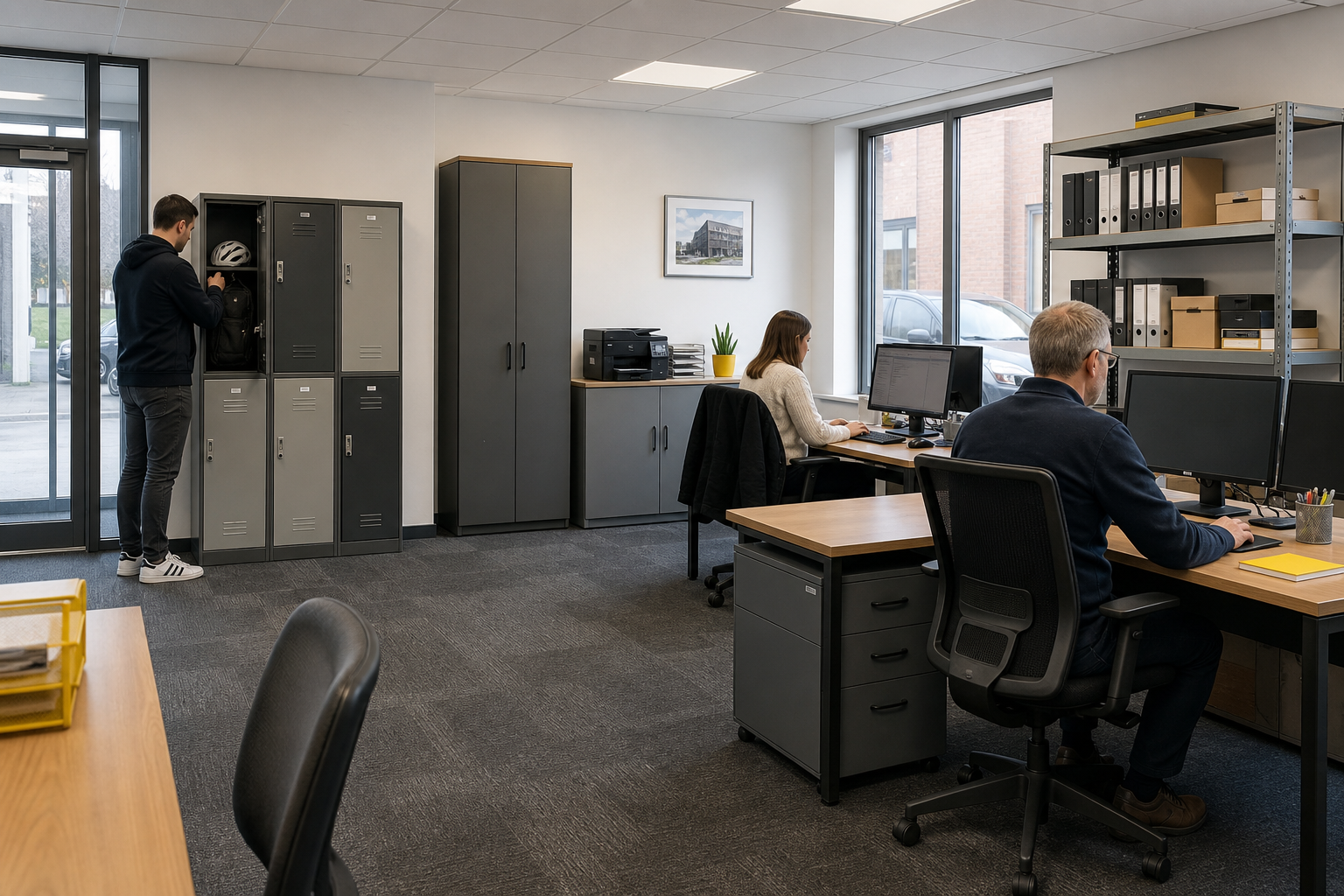
Standardise what users notice and operations need: labelling, lock responsibility, shelf categories, height bands and the finish palette. Then let different storage types do their own jobs. A coordinated room can combine steel lockers, wood-effect cupboards and mobile pedestals if the positions and visual rhythm are deliberate.
WRAP case studies show the practical circular value of keeping workplace furniture in use through reuse and remanufacturing. The environmental case is most credible when the selected storage fits, is structurally suitable and avoids another premature replacement.
- Prioritise adaptable shelves, replaceable locks and available components.
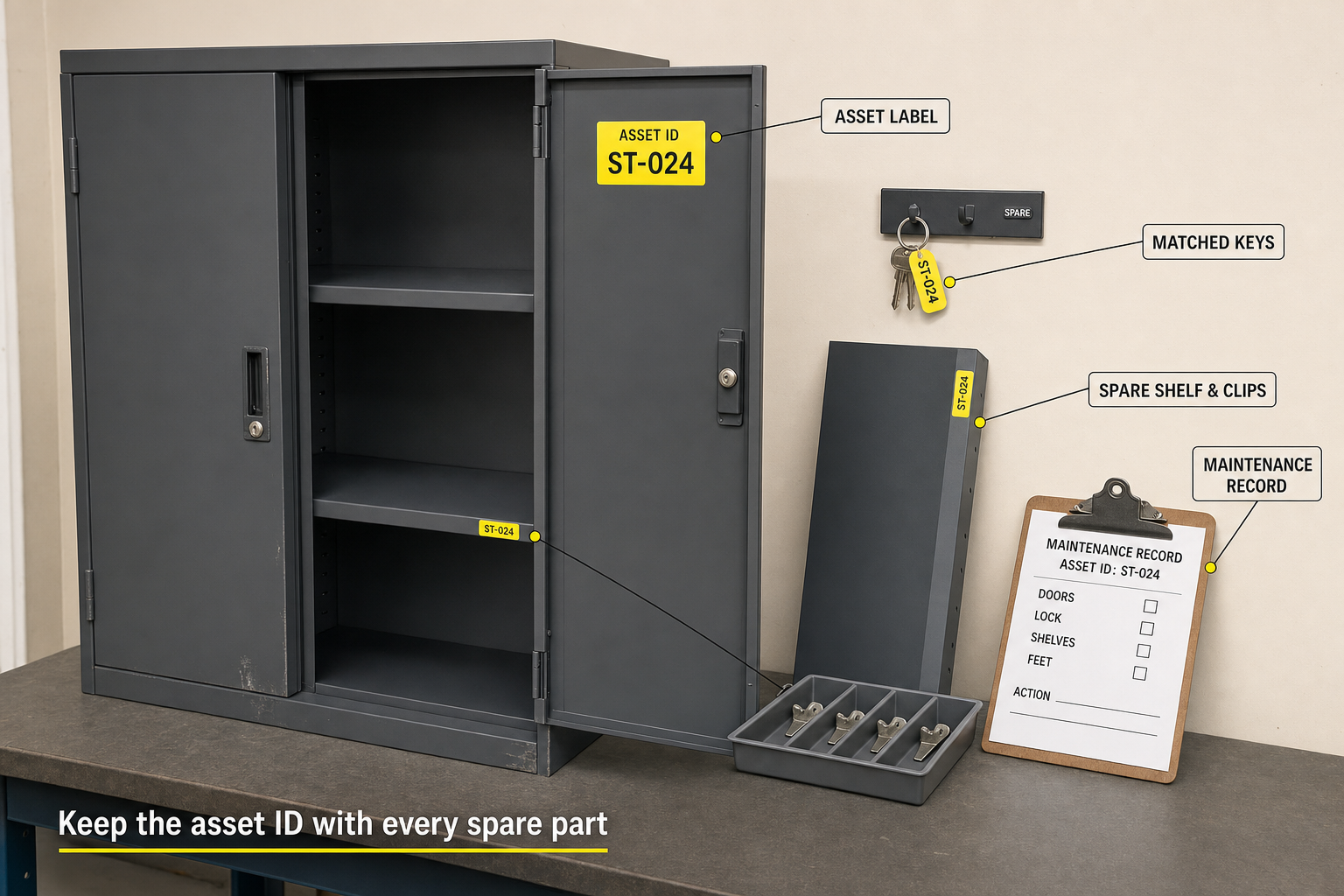
- Keep an asset record for keys, codes, locations and condition.
- Choose quantities and sizes that can move with credible workplace changes.
- Plan how the product could be reused, reassigned or responsibly recovered later.
Used Office Storage Buying Checklist
Confirm the contents, users, format, condition, room and delivery as one decision before ordering.
Contents
- Inventory grouped by size and use
- Largest item measured
- Active and archive stock separated
- Dense items identified
- Removal and retention reviewed
People & access
- Named owner or team
- Daily reach zone planned
- Accessible approach considered
- Keys, codes and master access defined
- Leaver and reassignment process set
Capacity
- Internal dimensions confirmed
- Door or drawer clear opening checked
- Shelf count and spacing suitable
- A4 or foolscap format verified
- Modest growth allowance included
Product condition
- Carcass and back stable
- Doors, hinges and runners tested
- Shelves, clips and dividers present
- Locks and every key counted
- Feet, castors and fixings complete
Room & safety
- Open doors and drawers drawn
- Escape and circulation routes clear
- Floor and wall suitability checked
- Load information available
- Fixing and inspection needs assigned
Delivery & handover
- Largest component measured
- Whole access route checked
- Handling people and aids planned
- Assembly and installation space reserved
- Labels, keys and asset record handed over
Frequently Asked Questions About Used Office Storage
Direct answers for buyers comparing categories, capacity, security, condition and installation.
What types of used office storage are available?
Common used office storage includes lockers, coat stands and garment rails, cupboards, mobile or desk-high pedestals, shelving and racking. Filing cabinets are a related category for structured paper filing.
Which office storage type should I choose?
Choose by what is stored, who needs it, how often they need it and whether access must be controlled. Lockers suit personal items, cupboards suit shared supplies, pedestals suit daily desk-side items, garment storage suits coats and shelving suits visible or boxed stock.
Is an office cupboard better than open shelving?
A cupboard hides contents and may offer lockable access, while open shelving makes frequently used items easier to see and retrieve. The right choice depends on privacy, visual order, item size, access frequency and the room.
What is the difference between a pedestal and a filing cabinet?
A pedestal is compact desk-side storage for stationery, personal items and sometimes suspended files. A filing cabinet is primarily designed around organised document filing and may offer greater dedicated file capacity.
How do I choose the right office locker size?
List the largest item each user needs to store, such as a backpack, helmet, laptop bag or coat, then check the clear internal compartment dimensions, shelves, hooks, door opening and lock mechanism.
Are used office lockers secure?
Security depends on the cabinet, door, hinges, lock type, key or code control and how the locker is installed. Inspect every compartment and choose a security level that matches the value and sensitivity of the contents.
What if a used locker or cupboard has missing keys?
Ask exactly how many working keys are included and whether locks can be replaced, codes reset or master access provided. Do not assume a matching key can be sourced after delivery.
Should I buy a coat stand or a garment rail?
A coat stand uses little floor space and suits lighter everyday use. A garment rail holds more items in a line and can suit teams or visitor areas, but it needs a stable base, suitable hangers and a planned footprint.
Which cupboard door type is best for a small office?
Tambour or sliding doors avoid the swing space required by hinged doors, which can help in tighter rooms. Hinged doors provide a wide opening when there is enough clear space in front.
How do I calculate office storage capacity?
Count or measure the real contents first, group them by size and access frequency, then compare those dimensions with usable internal shelf, drawer or compartment space. External cabinet dimensions do not equal usable capacity.
Will A4 and foolscap files fit every pedestal?
No. Drawer depth, rail spacing and filing direction vary. Confirm the intended paper format, whether rails are included and whether files hang front-to-back or side-to-side before buying.
How much weight can used office shelving hold?
Capacity depends on the exact shelf, span, frame, fixings and installation. Use the manufacturer's load information where available and never infer a safe load from appearance alone.
Does office racking need to be anchored?
The correct fixing and inspection regime depends on the racking system, height, loads, floor, wall and site use. Follow the manufacturer's instructions and use a competent installer or racking specialist where required.
Can lockable office storage protect confidential records?
Lockable storage can be one useful physical control, but it is not a complete data-protection system. Control who has keys or codes, document access, manage records properly and match the controls to the sensitivity and risk.
What should I inspect on used office storage?
Check the carcass, back, shelves, clips, doors, hinges, runners, handles, locks, keys, castors, levelling feet, bracing, labels and fixings. Test every moving part and confirm all removable components are present.
Can I mix office storage brands and finishes?
Yes. Consistent height, depth, colour family, handle style and condition often create a more coordinated result than matching brand names. Do not mix structural racking components unless compatibility is confirmed by the manufacturer or a competent specialist.
How do I measure for storage delivery?
Measure the largest delivered component against doors, corridors, corners, stairs, lifts and the final position. Include handles, packaging, carrying angles and space to assemble, level or fix the storage safely.
How can I stop tall office storage from becoming unstable?
Place it on a suitable level surface, distribute loads sensibly, fit all supplied components and follow the manufacturer's fixing instructions. Tall, narrow or heavily loaded units may require appropriate restraint or professional installation.
How should accessible office storage be planned?
Provide a clear approach, reachable everyday storage and doors or drawers that can be operated without blocking the route. Consider the actual users and current access guidance rather than placing every important item at one standard height.
Is buying used office storage more sustainable?
Keeping suitable commercial storage in productive use can extend its working life and reduce demand for replacement products. The strongest reuse decision is a unit that fits, functions safely and is likely to remain useful.
What storage works best in a small office?
Use the full room height carefully, place frequently used items within easy reach and choose the door style around the available floor space. A desk-side pedestal plus one well-planned cupboard can be more useful than several poorly placed units.
Where can I buy used office storage in the UK?
Specialist used-office-furniture suppliers sell lockers, cupboards, pedestals, coat storage, shelving and racking. My Used Furniture lists changing commercial stock and supplies customers across the UK mainland, subject to product and delivery requirements.
Shop Used Office Storage
Compare current lockers, coat storage, cupboards, pedestals, shelving and racking, then verify the exact dimensions, components, condition, access and installation before ordering.
Current stock · All office storage
Browse the complete Storage category
Used stock changes as products are sold and added. Shortlist from the live range, then apply the inventory, capacity, condition, room and delivery checks in this guide.
Store the work, not the clutter.
Define the contents, access and room first. Then choose used storage that is easy to reach, reliable to operate and realistic to deliver.
