



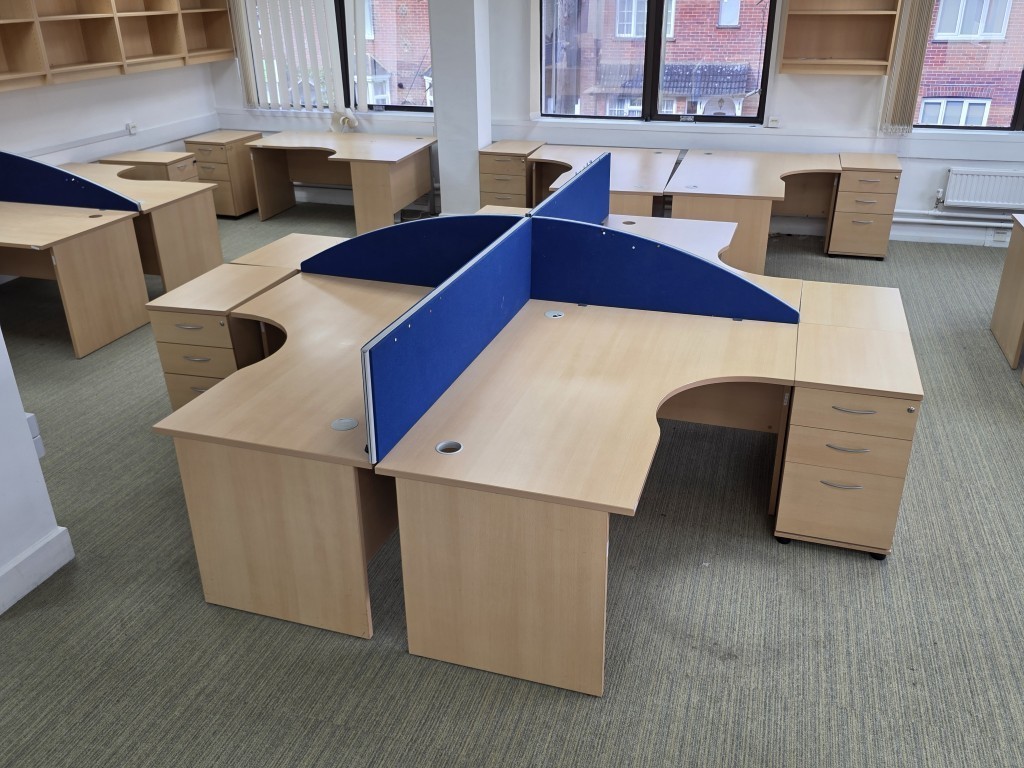
01 · The verdict
Do not compare the names. Compare the desk.
There is no reliable industry-wide rule that makes every “L-shaped desk” one product type and every “corner desk” another. Retailers and manufacturers use overlapping language.
An L-shaped desk normally has two perpendicular work areas: a main worksurface and a shorter side section, commonly called the return. A corner desk can have that same shape, but the term is broader. It may also describe a compact one-piece workstation with a curved or angled inner edge, or simply any desk intended to use a room corner.
That means two listings with different names may show functionally similar desks, while two products both called “corner desks” may have very different footprints.
A shape description
Usually a main surface plus a perpendicular return, creating two connected work zones.
A broader placement or retail term
May be L-shaped, curved, diagonal, wave-shaped or designed to face directly into a corner.
The useful buying rule
Ignore the label until you have checked the plan shape, maximum width and depth, return orientation, frame position, cable routes and the space needed for the chair.
02 · Terminology
Four desk terms buyers regularly find mixed together.
Knowing the small differences helps you read listings accurately—especially when buying used stock from different manufacturers.
L-shaped desk
A desk whose plan view forms an L. It may be one continuous top or several connected components.
Corner desk
A broad term for a workstation intended for a corner or sold within a corner-desk family. Its exact geometry varies.
Desk with return
A main desk with a secondary surface attached at roughly 90 degrees. The return creates many commercial L-shaped configurations.
Wave desk
An asymmetrical one-piece worktop that is deeper on one side. It can be handed without having a separate full return.
Commercial manufacturers illustrate both L configurations and desk returns in their specification material. The naming can describe the completed shape, the individual component or the intended configuration—which is why the final plan view matters more than a single product term.
03 · Direct comparison
L-shaped desk vs corner desk at a glance.
| Question | L-shaped desk | Corner desk |
|---|---|---|
| What does the name describe? | Usually the plan shape. | Placement, orientation, shape or retail category. |
| Typical construction | Main desk plus return, or one integrated L-shaped top. | Could be an L-shaped return desk, a one-piece corner top or a shaped workstation. |
| Must it sit against two walls? | No. Some work as room dividers or freestanding workstations. | No, despite the name. Check the finished sides, frame and cable routes. |
| Is it handed? | Often. The return may sit left or right of the seated user. | Often, but a symmetrical corner workstation may not be. |
| Does it automatically save space? | No. It offers more surface but can have a large maximum depth. | No. Some use corners efficiently; others occupy a substantial footprint. |
| Main buying risk | Ordering the wrong return side or underestimating the full footprint. | Assuming the category name tells you the exact shape. |
04 · The real differences
Six details matter more than the wording.
One top or two connected runs?
A full return creates a more obvious second work zone. A compact shaped top may offer less usable depth at its narrowest point.
Which side carries the deeper surface?
Check from the seated user's position. On My Used Furniture, a left-hand return sits to the user's left; a right-hand return sits to the user's right.
Width alone is not enough.
An advertised 1600mm width does not reveal how far the return projects into the room. Record maximum depth as well.
Can the user reach the work area?
A curved inner edge, scallop or corner section can affect how close the user sits and where monitors can be positioned.
Integrated, fixed or modular?
A detachable return may help with access and future reconfiguration. Confirm all legs, brackets, beams and fixings are included.
Where do power and data cross the L?
Look for cable ports, trays and gaps between components. A generous surface can still become awkward if cables must cross walkways.
The UK's Health and Safety Executive advises employers to assess the whole workstation, including equipment, furniture, working conditions and the job being done. The better desk is therefore the one that supports the real workstation—not whichever label sounds more suitable.
05 · Choosing
Which desk is better for your office?
Choose by task and room. The comparison is not really L-shaped versus corner; it is one physical configuration versus another.
Choose a full L-shaped desk or desk with return when:
- The user needs separate zones for computer work, paperwork or equipment.
- A larger secondary surface will be used regularly rather than becoming spare storage.
- The room can accept the full return depth without narrowing circulation.
- You have confirmed the correct left- or right-hand orientation.
Choose a compact corner or shaped desk when:
- The workstation needs to face directly into a corner.
- You want more depth near the user without a long, separate return.
- The room is too narrow for a full commercial L configuration.
- The plan shape creates a workable monitor position and sufficient legroom.
Choose a rectangular desk instead when:
- The office layout may change frequently.
- You need desks that align cleanly in rows or back-to-back layouts.
- The user does not need the additional return surface.
- Matching, reconfiguration and simple access matter more than maximum surface area.
For the wider decision—including desk sizes, bench systems, rectangular desks, sit-stand options and delivery—use our Used Office Desks Buying Guide.
06 · Before ordering
Measure the L, the chair and the route around them.
A plan that shows only the desktop outline is incomplete. The occupied workstation includes the chair, the person using it and the route past it.
Stand where the user will sit
Use the seated perspective when confirming whether the return must be on the left or right.
Record maximum width and maximum depth
Measure the longest run in both directions. Do not assume the listing's main width includes every return or overhang.
Draw the desk at scale
Add walls, doors, windows, radiators, columns, cupboards and neighbouring workstations.
Add the occupied chair position
Allow room to pull the chair back, change position and reach the workstation without trapping the user.
Protect circulation and cable routes
Check paths to doors, storage and shared areas. Keep cables away from routes where they could create a trip or snag hazard.
Measure the delivery route
Confirm doors, corridors, lifts, turns and stairs. Ask whether the desk is delivered assembled or dismantled.
Handedness check
Do not rely on “left” or “right” without a picture. Seller conventions can vary. Match the product plan view to the seated position and confirm which section is deepest.
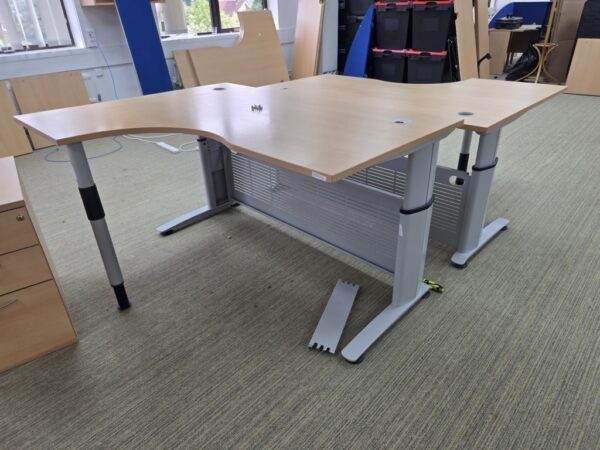
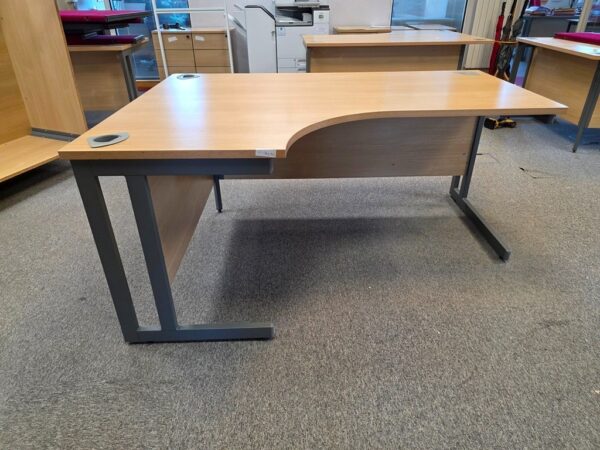
Current left-hand desks
Compare the photographs and dimensions with the return positioned to the seated user's left.
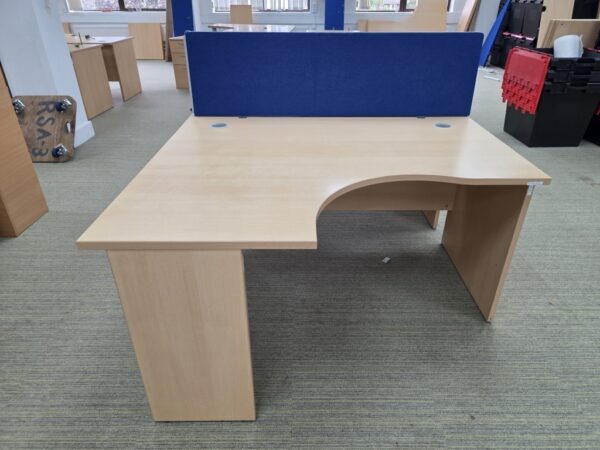
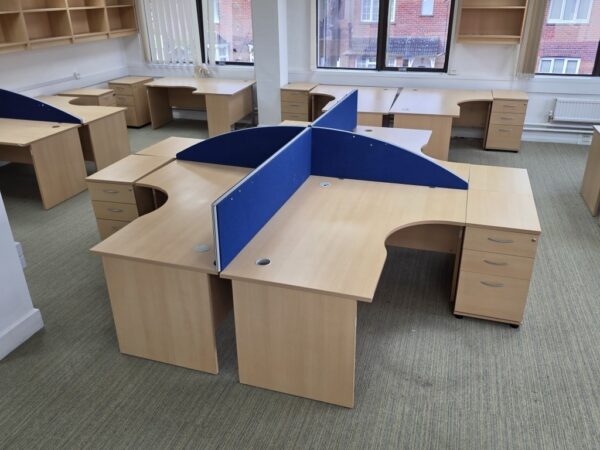
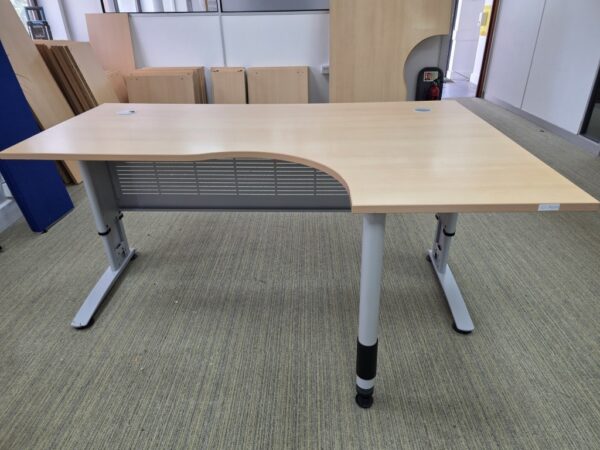
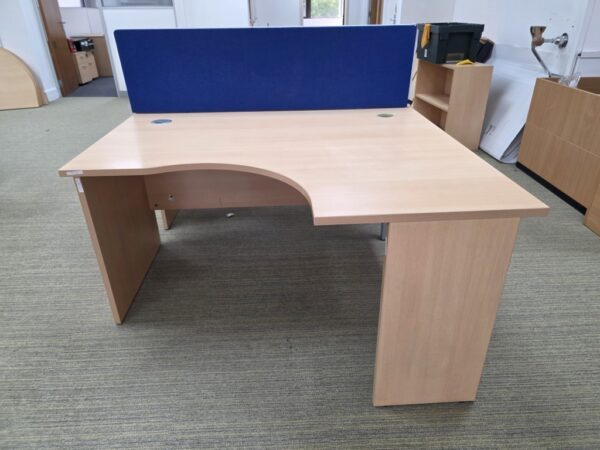
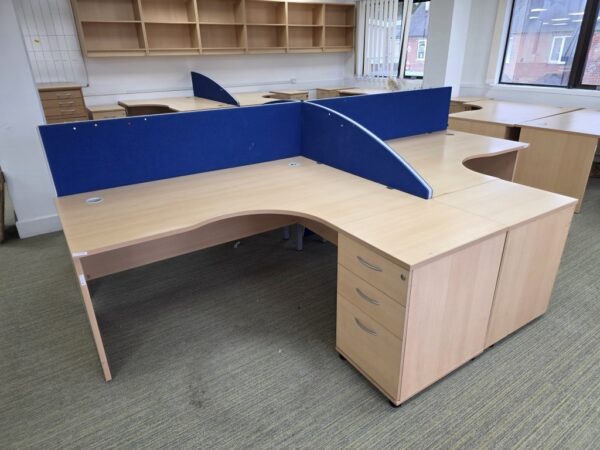
Current right-hand desks
Compare the photographs and dimensions with the return positioned to the seated user's right.
07 · Used desk checks
The return adds more parts worth inspecting.
Used commercial desks can offer substantial working surfaces without automatically paying new-furniture prices, but a multi-part configuration needs a complete component check.
Edges, joins and repairs
Inspect both surfaces, the inner corner, edge banding, cable-port cut-outs and any repaired areas shown in the photographs.
Legs, beams and return brackets
Confirm the desk has the supports required for both runs and that connection points are not loose or distorted.
Do not assume the pedestal is included
Check whether drawers, screens, cable trays, modesty panels, keys and joining hardware form part of the listing.
Know what must reconnect
Ask how the main desk and return separate for transport and whether specialist fixings or assembly instructions are available.
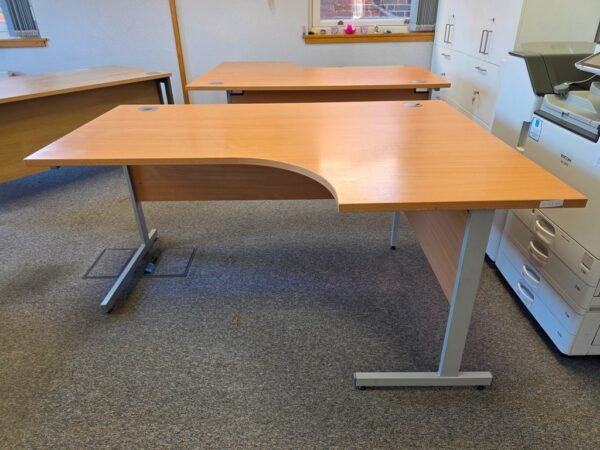
A current product can show why these details matter. Our left-hand L-shaped desk example identifies its orientation, 160cm width, variable 80–120cm depth, cable management, included pedestal, condition and dismantled delivery. That information is more useful than “corner desk” by itself.
08 · FAQs
L-shaped and corner desk questions.
Are L-shaped desks and corner desks the same thing?
Often, but not always. L-shaped describes the plan shape. Corner desk can describe an L-shaped desk, a compact desk designed to face into a corner or a broader retail category. Compare the actual geometry and dimensions.
What is the return on an L-shaped desk?
The return is the secondary worksurface extending at roughly a right angle from the main desk. It creates the shorter leg of many L-shaped configurations and may be fixed, detachable or integrated.
What does left-hand or right-hand corner desk mean?
On My Used Furniture, the orientation is viewed from the seated user's position: left-hand means the return is on the user's left; right-hand means it is on the user's right. Always confirm this against the photographs and dimensions.
Does an L-shaped desk save space?
It can use a suitable corner efficiently, but it does not automatically occupy less floor space. Measure the full width, maximum return depth, chair movement and circulation area.
Can an L-shaped desk be used away from a wall?
Yes, if its frame, modesty panels, cable management and exposed edges suit the layout. Some work well as room dividers or freestanding individual workstations.
Is a wave desk the same as an L-shaped desk?
Not necessarily. A wave desk usually has one asymmetrical worktop that is deeper on one side. It can be left- or right-handed without having a distinct secondary return.
Sources and review basis
- UK Health and Safety Executive: DSE workstation assessment
- UK Health and Safety Executive: Working with display screen equipment
- Global Furniture Group: planning L desk surfaces
- Haworth X Series specification material: desk returns and orientation
- My Used Furniture category structure, live product information and used-stock inspection experience.
