Comparison guide · Storage & filing · 03
Office shelving vs cupboards: open access or a closed front?
Doors can make an office look tidy, but they can also hide a poorly organised storage system. Open shelves can be efficient, provided the contents belong in plain sight.
Get the short answer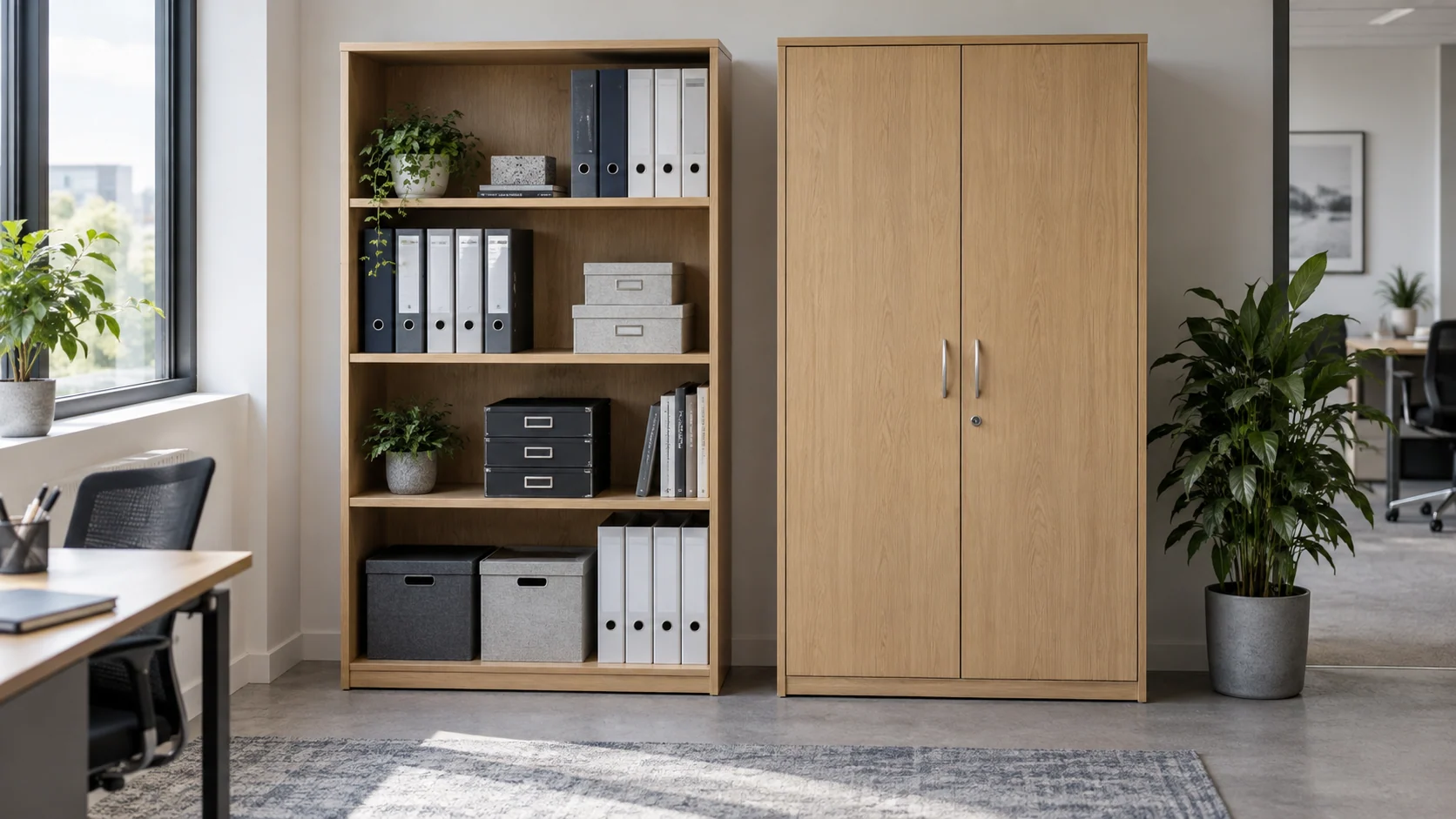
Short answer
Open shelving suits contents that need quick, visible access and do not require enclosure. Cupboards suit mixed or visually untidy contents and situations where doors or locks serve a purpose. A combined arrangement can separate daily-use supplies from less frequently accessed items.
Choose on purpose
Which option fits which situation?
Choose open shelving for frequently collected items that can remain visible and do not need an enclosed front.
Choose cupboards when concealment or controlled access is useful, provided the door opening still allows convenient retrieval.
Side by side
Office shelving vs cupboards
| Decision | Office shelving | Office cupboards |
|---|---|---|
| Access | Contents visible without opening doors | Doors add a step before access |
| Presentation | Organisation remains on display | Contents can be concealed |
| Protection | Open to the room | Some enclosure, but not a sealed environment |
| Security | No inherent locked front | Locks may be available; specification varies |
| Floor use | No door arc, but user space still needed | Allow for the actual opening mechanism |
| Inspection | Shelves, supports and stability | Also inspect doors, hinges, tracks and locks |
Know what is being compared
Office shelving
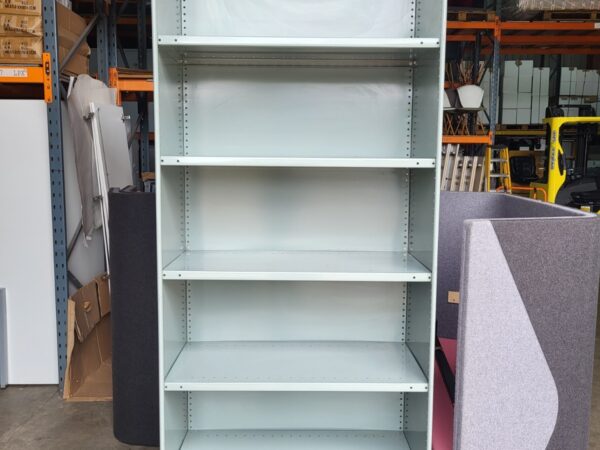
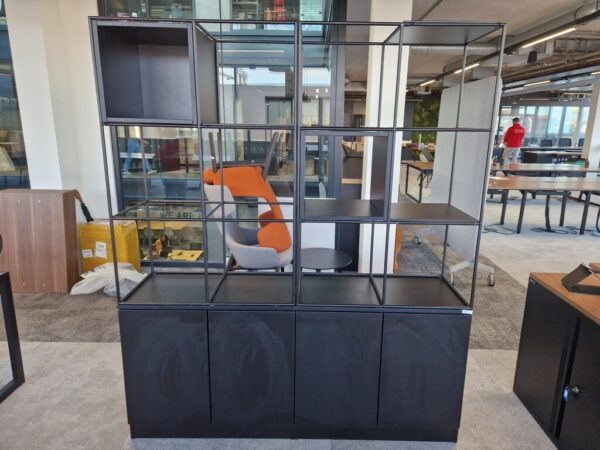
Office shelving provides open shelves without a full closing front. It is different from industrial racking, which has its own loading and installation requirements.
Office cupboards
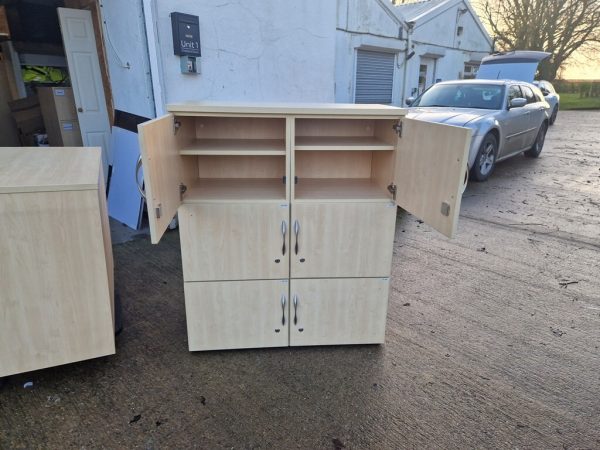
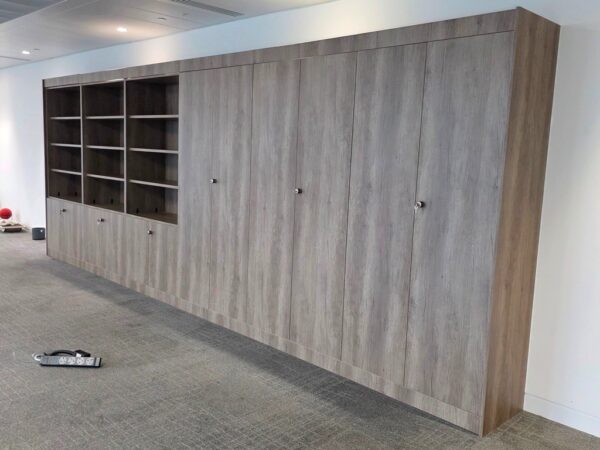
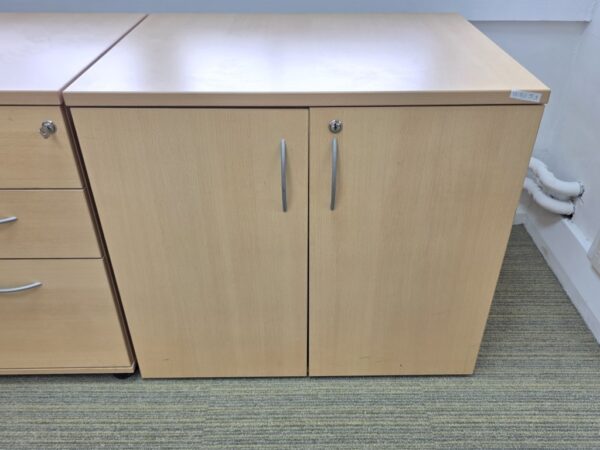
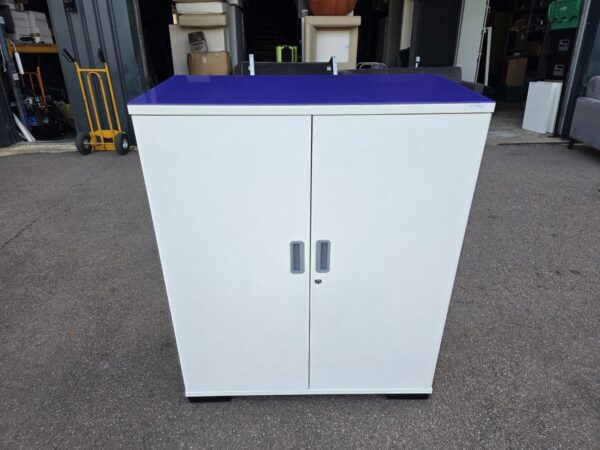
Office cupboards enclose shelves or other fittings behind doors. Hinged, sliding and tambour fronts have different opening-space requirements.
Worked measurement
A box must pass through the opening, not just fit inside
Illustrative fit: a 380 mm-wide box is being considered for a cupboard with 400 mm of internal width but only 360 mm of clear opening.
| Check | Option or calculation | What it tells you |
|---|---|---|
| Inside width | 400 mm | Looks sufficient for a 380 mm box |
| Clear opening | 360 mm | Too narrow for straight-on access in this example |
| What to check | Hinges, door position and box handling | Do not rely only on internal shelf dimensions |
Tilting a box might be possible, but that is not the same as convenient everyday access. Consider its depth, contents and weight before treating a tight opening as workable. Open shelving removes the doors, although shelf supports and surrounding furniture can still restrict handling.
Keep access and loading as separate checks. A box fitting on a shelf says nothing about the load the shelf can safely take. Obtain product-specific loading and installation instructions, especially for used units with replacement shelves or missing supports.
Put it in a real room
The shared printer and supplies area
Open shelves could hold paper and supplies that staff collect every day, while a cupboard stores less frequently used or visually untidy items. The layout should also leave space for someone replenishing stock without blocking the printer. This mixed approach may work better than forcing every item behind a door or leaving everything permanently on display.
The details that change the decision
Visibility is useful when it supports the workflow
Open shelves can make shared supplies easy to find and restock. They are less helpful when every shelf contains unrelated items with no clear system. Containers and consistent labels can improve use, but they should not conceal an unsuitable shelf depth or difficult reach.
Cupboards can reduce visual clutter in a shared office or reception. However, adding doors does not increase internal organisation. Decide what belongs on each shelf and how often it will be retrieved before choosing the front.
Measure the usable shelf, including the opening
Check clear width, depth and height between shelves. A box may fit inside a cupboard but fail to pass easily through the opening beside a hinge or partially retracted door. Open shelving avoids that particular obstacle, not every access problem.
Deep shelves may hold more in theory but encourage items to disappear behind one another. Compare your actual boxes, binders and equipment with the shelf layout. Frequently used items should not require unloading an entire row to reach them.
Storage loads need the correct structure
Paper and equipment can become heavy quickly. Confirm the manufacturer’s shelf and unit loading information and follow installation or anchoring requirements. Do not treat an attractive open bookcase as interchangeable with a rated commercial storage system.
For used units, inspect shelves for bowing, check that support clips are complete and look for damaged joints or an out-of-square carcass. On cupboards, test the entire door travel and any locks. Cosmetic condition and structural condition are separate questions.
Before ordering
Five checks worth doing
- 01List what must be visible, concealed or access-controlled.
- 02Measure containers against clear shelf dimensions.
- 03Confirm shelf quantity, adjustment and loading information.
- 04Check supports, joints, stability and installation requirements.
- 05Allow space for retrieval, replenishment and any door movement.
Clear answers
Frequently asked questions
Do cupboards keep everything dust-free?
No. Ordinary office cupboards provide enclosure but are not sealed storage unless specifically designed that way.
Is open shelving better in a small office?
It removes door movement, but depth, reach and visual clutter still matter. Compare the complete arrangement.
Can I add doors to existing shelving?
Only if the range supports compatible doors and fittings. Do not assume a similar-sized door will fit or preserve the intended structure.
Ready to compare real options?
Take the brief to current stock.
Use your contents list and internal measurements to narrow down current storage options. Condition, quantity, price and delivery can change, so verify the current listing and order details.