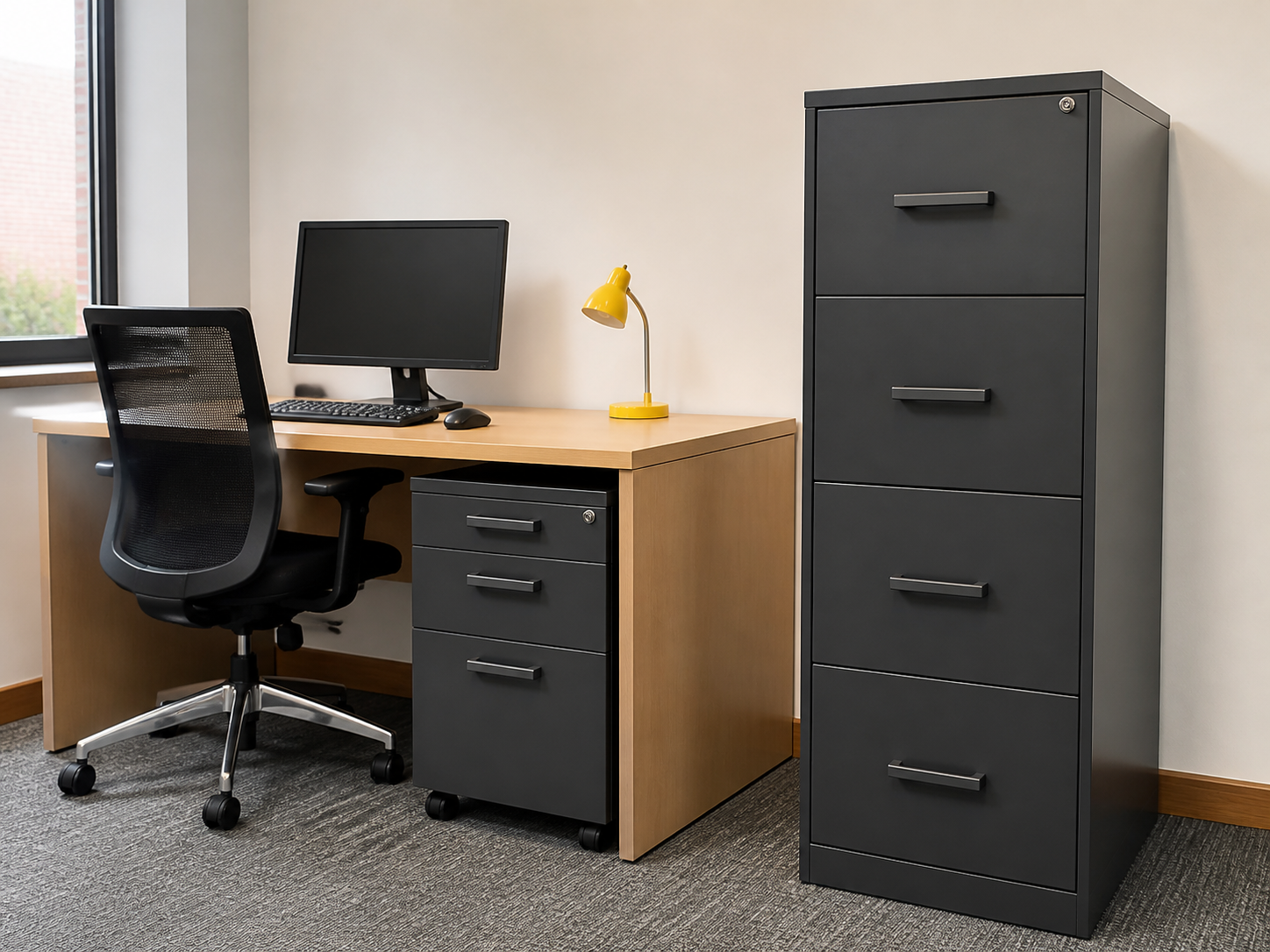
01 · Decision in 30 seconds
Start with the person—or start with the paperwork.
That single distinction resolves most purchases. Pedestals follow users and desks. Filing cabinets follow document systems, retention needs and controlled access.
Daily reach matters most.
One person needs stationery, personal items and a manageable amount of active filing directly beneath or beside the desk.
File capacity matters most.
Several drawers must organise A4 or foolscap suspension files, often as shared, departmental or longer-term record storage.
01 · ContentsMixed items?Pedestal usually wins.
02 · FormatMostly files?Filing cabinet usually wins.
03 · UserOne assigned person?Pedestal stays close.
04 · VolumeSeveral drawers of records?Use dedicated filing.
02 · Decode the storage
One lives with the desk. The other becomes part of the records system.
Mobile pedestal
A compact cabinet on castors, normally sized to sit beneath or beside a desk. Drawer combinations vary; a common layout mixes shallow utility drawers with one deeper drawer.
Desk-high pedestal
A taller pedestal intended to sit alongside a desk and sometimes extend the worksurface. Height, depth and finish need to align with the workstation.
Vertical filing cabinet
A narrow, deeper cabinet where suspension files commonly run front to back. It concentrates several filing drawers in a relatively small width.
Lateral filing cabinet
A wider, shallower filing format where files may run side to side. It can provide a broad top surface but requires more wall width.
Drawer count does not tell you drawer purpose.
A three-drawer pedestal may contain three shallow utility drawers. A two-drawer pedestal may contain one utility drawer and one full filing drawer. Inspect the internal layout.
03 · Direct comparison
Pedestal cabinet vs filing cabinet at a glance.
| Decision | Pedestal cabinet | Filing cabinet |
|---|---|---|
| Primary job | Daily desk-side storage for one user. | Organised storage for paper records. |
| Typical contents | Stationery, chargers, personal items and some active files. | A4 or foolscap suspension files across dedicated drawers. |
| Position | Under a desk, beside it or aligned at desk height. | Against a wall or within a shared records area. |
| Mobility | Often fitted with castors; some are fixed or desk-supported. | Normally intended to stay in one planned position. |
| Capacity | Lower overall file capacity because drawers serve mixed purposes. | Higher dedicated file capacity, depending on drawer count and width. |
| File compatibility | Only when the deep drawer, rails and clear depth match the file format. | Designed for filing, but A4, foolscap and rail direction still need confirmation. |
| Typical user | Assigned employee or workstation. | Individual, team, department or controlled records function. |
| Main buying mistake | Assuming a deep drawer is ready for suspension files. | Buying capacity without checking format, security or the space needed for open drawers. |
04 · Capacity & formats
The outside dimensions sell the cabinet. The inside dimensions decide whether it works.
Do not compare capacity by drawer count alone. Compare usable filing length, internal clear width and depth, rail spacing, filing direction and the real folder format.
A4 is not the same as foolscap
Foolscap suspension files are larger than A4 paper. A cabinet described casually as “A4” may not accept your existing file set in the expected direction.
Front-to-back or side-to-side?
The file orientation affects compatibility, browsing and how much filing length is available in each drawer.
Will folders close without crushing tabs?
Measure the hanging file, label tab and contents—not only the paper inside it. The drawer must close freely without bending folders.
Are the rails actually included?
A deep drawer may need rails, dividers or conversion bars. Confirm every fitting rather than assuming the visible drawer is file-ready.
Can users browse the files?
Overpacked drawers may technically hold more but become slow to use. Leave enough movement to identify and remove folders.
Are you storing or merely postponing disposal?
Review retention and disposal rules before buying furniture for records that no longer need to be kept.
For a fuller walkthrough of A4, foolscap, suspension files, drawer rails and office storage formats, use our Used Office Storage Buying Guide.
05 · Choosing
Match the cabinet to the rhythm of the work.
Choose a pedestal cabinet when:
- One user needs frequent access without leaving the workstation.
- The contents mix stationery, devices, personal items and a small active-file set.
- The unit must fit beneath a desk or align beside it.
- The office changes layout and mobile storage would help.
- You have confirmed that the cabinet does not remove necessary leg or foot space.
Choose a filing cabinet when:
- Suspension files are the main contents rather than one drawer among several.
- The organisation needs several drawers of structured records.
- Access is shared, departmental or controlled by role.
- A permanent records position works better than storage attached to one desk.
- The room can accommodate the cabinet and every fully extended drawer.
Use both when:
- Staff need active working files close by but older or shared files belong in a central system.
- Personal storage should move with workstation assignments while records remain controlled.
- The pedestal handles the working day and the filing cabinet handles the retention structure.
The smart split: active versus retained.
Keep only genuinely active material at the desk. Move shared or retained records into a controlled filing system, and dispose of records securely when the approved retention period ends.
06 · Locks & record security
A lock is a feature. Security is a system.
A lockable cabinet can support controlled storage, but the cabinet cannot decide who should have a key, what belongs inside or when records should leave.
Who genuinely needs the records?
Assign access by role and purpose. Desk-side convenience should not override the sensitivity of the information.
Where are spares and codes controlled?
Confirm keys exist, identify the lock code where visible and keep spares away from the cabinet itself.
Can unauthorised people reach it?
A lockable pedestal in an open visitor area may still be a poor location for sensitive records.
Should the paper still exist?
Capacity does not justify indefinite storage. Link the cabinet to an approved retention and secure-disposal process.
The Information Commissioner's Office advises organisations to securely store paper records and control access. In its employment guidance, the ICO gives a locked filing cabinet as one possible physical control for sensitive sickness records. That is an example of an appropriate measure—not proof that every lockable drawer suits every record.
07 · Fit & placement
Measure the cabinet closed. Plan the cabinet open.
Record the full external size
Measure width, depth and height, including handles, top overhangs, castors and levelling feet.
Add maximum drawer extension
Draw the cabinet with its deepest drawer fully open. Protect walkways, chair movement, cupboard doors and nearby workstations.
Check the desk structure
For pedestals, measure beneath beams, cable trays and sit-stand frames. Confirm that the user retains adequate knee and foot space.
Plan the loaded position
Place the cabinet on a suitable level surface and follow product instructions. Do not defeat any fitted interlock or anti-tilt mechanism.
Measure the delivery route
Check vehicles, doors, corridors, lifts, stairs and turns. The HSE notes that load size and shape—not only weight—can make handling difficult.
Decide who moves it
Empty files before relocation unless a competent assessment and handling plan says otherwise. Secure drawers and keep keys controlled.
08 · Used storage checks
The drawer front can look perfect while the mechanism tells another story.
Used commercial storage is valuable when its small working parts are intact. Inspect the components that carry the load and control access—not only the paint or laminate.
Full travel without dropping or binding
Open every drawer through its complete movement. Listen for grinding, check side play and confirm the drawer closes squarely.
Mechanisms must remain intact
Check drawer stops and any system that limits multiple drawers opening. Never force or bypass a safety mechanism.
File-ready means components included
Confirm rails, bars, dividers and trays match the intended format and are present in the supplied quantity.
Test the lock across its full range
Check which drawers the lock controls, whether keys are included and whether the lock code is legible for replacements.
Every contact point carries the cabinet
Look for missing castors, flat spots, loose fixings and damaged levelling feet. Confirm suitability for the final floor.
Square, stable and free from distortion
Inspect corners, top, drawer gaps, handles, corrosion, swollen laminate and signs that the cabinet has been overloaded.
Current used pedestal cabinets
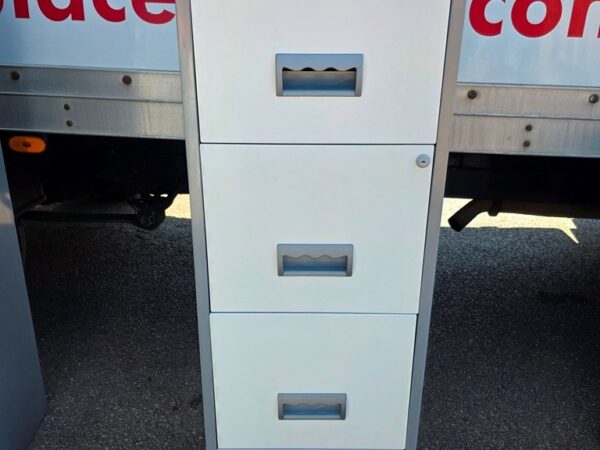
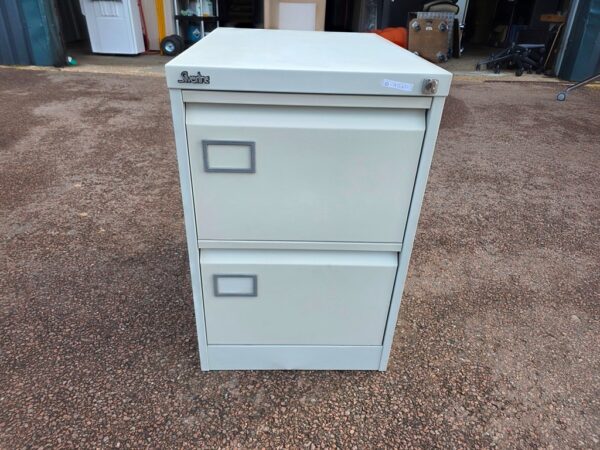
Compare drawer combinations, castors, height, depth, locks, keys and file fittings against the desk and user.
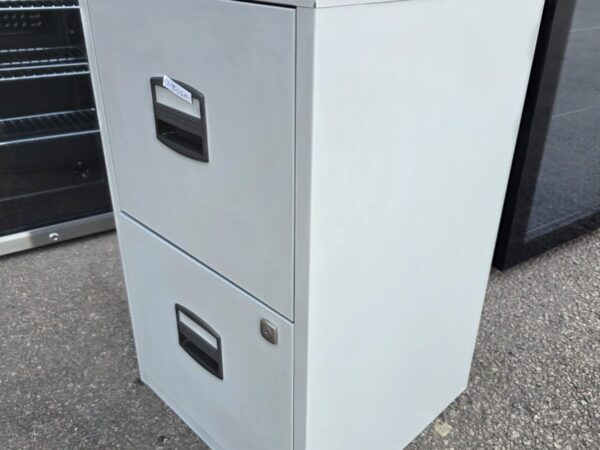
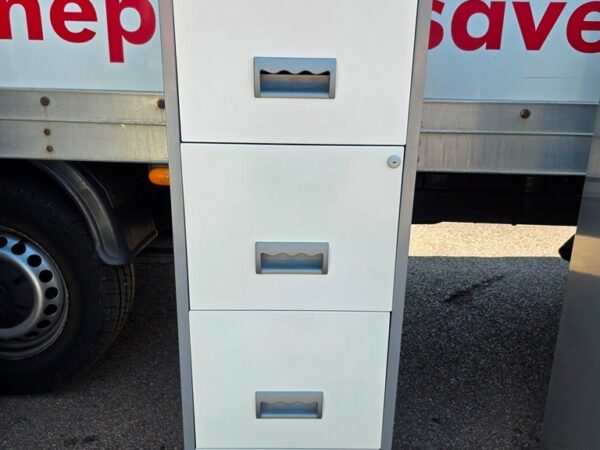
Current filing cabinets
Compare drawer count, A4 or foolscap compatibility, rail direction, condition, locks and the open-drawer footprint.
09 · FAQs
Pedestal and filing cabinet questions.
What is the difference between a pedestal cabinet and a filing cabinet?
A pedestal is compact desk-side storage for daily stationery, personal items and sometimes files. A filing cabinet is designed primarily around organised paper-file capacity across dedicated drawers.
Can a pedestal cabinet hold suspension files?
Some can. The deep drawer needs the correct clear dimensions, rails, rail spacing and filing direction. Drawer depth by itself does not confirm compatibility.
Are A4 and foolscap filing cabinets the same size?
No. Foolscap suspension files are larger than A4 paper and rail spacing may differ. Confirm the file format, internal dimensions and orientation of the specific cabinet.
Which holds more files: a pedestal or filing cabinet?
A dedicated filing cabinet normally offers more file capacity because several drawers serve that purpose. A pedestal may devote only one drawer to filing.
Is a lockable filing cabinet enough for confidential records?
A lock is one control, not a complete system. Access rules, key management, secure placement, retention and disposal still need to match the sensitivity of the records.
What should I check when buying either cabinet used?
Check internal dimensions, drawer format, rails, runners, stops, interlocks where fitted, locks, keys, handles, castors or feet, frame condition and stability. Confirm the delivery route too.
Sources and review basis
- ICO: Records management and security
- ICO: Handling sickness and injury records
- ICO: Practical data-protection steps for small businesses
- HSE: Manual handling at work
- My Used Furniture category structure, live product details and used commercial-storage inspection experience.